Funding Opportunities in April

Newly Opened: Lloyds Bank Foundation – Local Collaborations Programme

This programme will support collaborations led by small charities seeking to influence and achieve local or regional change around improving the social security system, improving access to suitable accommodation, and support for asylum seekers and refugees. Collaborations can apply for grants of £100,000 over two years.

We would expect your influencing work to align with at least one of these themes:

making the social security system work better for those facing the greatest challenges;
making sure people facing complex issues have access to suitable accommodation;
improving support and services for asylum seekers and refugees.
This funding cannot be used to fund direct delivery of services and is exclusively to support partnerships to influence locally and regionally.

Apply for funding under our local collaborations programme.
Deadline: Complete the Expression of Interest by 30 April 2025

Newly Reopened: One Stop Community Grants

Successful applicants will receive an initial grant of up to £1,000 and begin a partnership with their local One Stop store.

This programme is designed to support community groups or organisations operating within two miles of a One Stop store and which are;

Tackling food poverty
Supporting the vulnerable
Supporting the elderly
Supporting low-income families
Running youth sports teams
Reducing / recycling waste
Improving the environment
Please note we cannot support food bank/breakfast club projects that are requesting funding to purchase food items. However please contact your local One Stop store manager as it may be possible to discuss setting up food bank donation point at your local store. Funding can be awarded to food banks for equipment such as fridges, freezers or to purchase storage units.

The programme provides partnership as well as financial assistance. Alongside a grant of up to £1,000, and the opportunity to create a long-term tailored programme of support for successful applicants with their local One Stop Store Team. Grant recipients then work in partnership with the One Stop Store Team at their local shop to deliver support to the community.

The tailored support from the store teams will help community causes to increase or improve their service by assisting in areas such as, but not limited to, volunteering support, fundraising and awareness-raising.

Please only submit one application, so please prioritise your key project and do not submit applications for more than one project and do not submit multiple applications but with different store postcodes. If you have received funding from One Stop Community Partnerships in the last 12 months you are ineligible to apply for funding on this occasion. If you have received funding for a project more than 12 months ago, you are welcome to apply.

Deadline:

Applications open Applications close Decision Date W/C
3 March 31 March 12 May
2 June 30 June 11 August
1 September 29 September 10 November

Eling Estate

The key objectives for the Trust and Estate include:

The advancement of the Christian religion and the teaching and usage of Orthodox Churches of the East;

The relief of sickness and/or poverty;

The long-term maintenance of the character of the Estate, and the local environment, and:

Management of the woodlands and other features of the Estate for the public benefit and to facilitate public access where appropriate.

The Trustees meet three times a year to consider applications for donations to charities. Applications are generally considered where they meet all of the following criteria:

An applicant must be an established registered charity;

The grant should relate to activities in West Berkshire or neighbouring counties;

We are not able to give to overseas charities or funds;

Grants for projects rather than general running costs are favoured;

Grants should fit into one or more of the following categories:

The advancement of the Christian religion and particularly the Greek and Russian Orthodox Churches;

Community or Education facilities and provision of support;

Social and Welfare support and therapy.

Applications should be made in writing, including a copy of the most recent charity accounts. Send to:

Shoosmiths Foundation

About Us: The Shoosmiths Foundation is a grant-making body working to help address societal issues, to empower sustainable change and to improve the lives of the people and the environment in the UK.
Criteria: Offering UK-based registered charities grants for projects that advance access to justice in Shoosmiths locations across the UK. Proposed projects should achieve one of the following:
Sustaining or improving community access to specialist legal advice.
Leveraging organisation’s and educational institution’s pro bono programmes to increase access to justice.
Projects must address underrepresentation and support intersectionality more broadly. For example, projects that not only support access to justice prospects but also address other factors of underrepresentation such as:

Characteristics listed in the Equality Act 2010.
Ex-military personnel.
People with convictions.
People experiencing homelessness.
Long-term unemployed.
Refugees.
Care-experienced individuals
Grant Size: Between £25,000 and £50,000
Deadline for applications: 4pm on 18th April

Matthew Good Foundation

About Us: Grants for Good is funded by the John Good Group and is designed to direct funding only to small and growing local charities, voluntary groups or social enterprises that are making a big impact on communities, people or the environment.
Criteria: To be eligible, applicants must:
Be a local community group, charity, voluntary group or social enterprise that has a positive impact on communities, people or the environment.
Have an average income of less than £50,000 in the last 12 months.
Have a bank account in the organisation’s name
Grant Size: Up to £5,000
Deadline for applications: Ongoing

CLA Charitable Trust

About Us: We support charitable organisations that access the benefits of the countryside to pursue the health and wellbeing of people and to provide opportunities for education about the countryside in England and Wales.
Criteria: The CLA Charitable Trust awards grants to small and medium sized charities and not for profit organisations such as CICs that access the benefits of the countryside to pursue the health and wellbeing of people and to provide opportunities for education about the countryside in England and Wales. The Trust prioritises organisations working with children and young people and those disadvantaged financially, physically, mentally, or from areas of deprivation.
Examples of eligible activities engaging young people and communities in these areas include, but are not limited to:

Farms providing day or residential experiences for disabled or disadvantaged young people.
Growing projects including horticultural therapy and community projects supporting people through outdoor activities and gardening.
Forest school type activities giving people the opportunity to utilise their outdoor spaces for the benefit of their mental and physical wellbeing.
Conservation and environmental projects giving people the chance to learn about the natural environment and how to care for it.
Grant Size: Up to: £5,000
Deadline for applications: Ongoing

Libraries Improvement Fund – Arts Council England

This fund will enable library services across England to invest in a range of projects to upgrade buildings and technology so they are better placed to respond to the changing ways people are using them.

Local authorities can apply for capital expenditure between £50,000 to £500,000.

Expressions of interest will open on 6 May and close on 30 May 2025.

The Big Bike Revival – Cycling UK

The Big Bike Revival is an intervention for adults aimed at encouraging an uptake in cycling. By providing solutions to perceived barriers, adults are enabled to learn to how to cycle and to increase their cycling levels for short, everyday journeys. Events focus on presenting cycling as a practical, normal and habitual way to get around locally.

The Big Bike Revival is delivered across England by a wide range of community-embedded partners. Typically, these are volunteer-led groups, not-for-profit organisations and social enterprises that are rooted in local communities and working to address a range of local needs. Such groups can apply for grants to run events as part of Big Bike Revival.

Grant funding is available for any amount up to £3,500.

For Grants of £2,000, partners should be able to deliver at least 6 events.
For Grants of £3,500, partners should be able to deliver at least 10 events.
Events must take place between 18 April and 31 October 2025. The deadline for applications is 14 July.

Physical Activity Grants Programme – Parkinson’s UK

This programme supports activity providers, communities, networks, organisations and others to develop opportunities for people with Parkinson’s to become and stay active.

Projects must run for a minimum of 12 weeks and a maximum of 52 weeks and must start within 12 weeks of receiving the grant.

Applications can be made for a minimum of £500 up to a maximum of £3,000. Up to 100% of costs are available if required,

Applications opened on 10 March and will remain open until all funds are allocated.

Football Foundation grants

Football Foundation grants are available to football clubs, schools, councils and local sports associations under the following categories:

Goalposts
Storage containers
Portable floodlights
Changing pavilions and clubhouses
3G pitch maintenance machinery and equipment
Fencing
3G pitches
Creation of new grass pitches
Small-sided facility improvements
Grass pitch improvement
Grass pitch drainage
Grass pitch maintenance machinery and equipment
Premier League defibrillator fund
Premier League stadium fund
Looking for funding | Football Foundation

Skipton Building Society Charitable Foundation

The Charitable Foundation has identified two focus areas through which it aims to drive social impact.

Helping people experiencing hardship and/or underserved groups to:

access a place to call home.
and improve financial wellbeing.
The trustees will select charities based on their alignment with one or both focus areas. The Foundation has committed to fund UK registered charities, where successful, up to a maximum of £10,000.

The current application round will close on 1 May 2025.

Community Tree Planting Fund – Network Rail

The Tree Council and Network Rail work in partnership to deliver a programme of community tree planting. Together, they have already planted more than 300,000 trees in 108 communities across the UK.

Funding for projects is awarded in three bands:

Main Grants – Projects between £2,500 and £5,000
Large Grants – Projects between £5,000 and £10,000
Flagship Grants – Projects over £10,000 and up to £15,000
Flagship Grants will be awarded in limited numbers to those projects that deliver a significant impact across our programme priorities.

Funding is now open and all details are on the website.

Network Rail Community Tree Planting Fund – The Tree Council

Healthy Heart Grants – Heart Research UK
Healthy Heart Grants of up to £15,000 are available for community projects aimed at supporting adults to reduce their risk of coronary heart disease, helping them to live healthier, happier and longer lives. The grants are available to charities and community interest companies across the UK.

The application windows for 2025 in England are:

England North: 7 May to 4 June
England South: 16 July to 13 August
Healthy Heart Grants – Heart Research UK

Youth Music Trailblazer Fund

The Youth Music Trailblazer fund offers grants of £2,000 to £30,000 to organisations in England to run projects for children and young people (25 or under) to make, learn and earn in music. The project should trial work or test a new way of working, sustain a grassroots programme or disrupt the status quo (or all three!).

Your work must meet one of the Fund’s themes:

Early years
Disabled, d/Deaf and neurodivergent young people
Youth justice system
Young people facing barriers
Young adults
Organisations and the workforce.
The deadline for applications is 11 April 2025.

Community support small grants – Trusthouse Charitable Foundation

Single year grants between £2,000 and £10,000 are available to charities and not for profit organisations for core costs, salaries, running and project costs. Projects must have a focus on Community Support and address urban and rural deprivation in the UK.

if you are located in a rural area, you must be in the bottom 50% most deprived areas according to the Index of Multiple Deprivation. Your annual income must not exceed £250,000 and you can secure 50% of the total project costs.

This is a rolling programme with no deadlines.

Neighbourhood Planning Grant Funding – Locality

Government has confirmed the continued importance attached to supporting neighbourhood planning and on 1 October 2024 launched the procurement process for the new contract for Neighbourhood Planning Support Services for 2025 to 2027. Government intend to sign the new contract in April 2025 for the new services to open from July 2025.

To read more on funding opportunities, click the Rural Services Network April 2025 Funding Digest.

Home Instead Charities

Money raised from our dedicated network of Home Instead Offices and external supporters fund groups who support the mental, physical, and emotional wellbeing of ageing adults.

If you are a small grass roots organisation you can apply for funding up to £500. If you are a small local registered charity you can apply for funding up to £1,500. If your group is a registered charity, you must attach a copy of your governing document AND your last set of accounts. If either of these documents are missing, we will not be able to process your application.

Most of your group members must be over 55 years old or the project you are requesting funding for must benefit people aged over 55. The project must support its members through activities and projects that support wellbeing or reduce social isolation and/or loneliness. Your group must be open and inclusive irrespective of race, religion, disability, sex or sexual orientation.

We will only fund individuals if it is to provide access to your group, i.e. transport costs or communications devices to access your groups activities. We will only fully fund grant requests from organisations who hold no more than 3 months operating costs in reserve. If you have more than this, the charity will only co-fund your project up to a maximum 50% of the funding required.

We will consider applications from groups, associations and charities that do not service the over 50s directly but the project they require funding for does, i.e., a local school wishes to hold a special afternoon tea for its local care home residents.

If you are a registered charity your application must be accompanied by a copy of your constitution and annual accounts.

The National Lottery – Reaching Communities

About Us: With this funding we’ll help strengthen communities and improve lives across England. Our funding is available to all communities. But our priority is the places, people and communities that need it most.
Criteria: Voluntary or community organisations in England. Our priorities are to fund projects that:
support places, people or communities experiencing poverty, disadvantage or discrimination
and
support people and communities to shape the decisions that affect their lives.
And your project must achieve one of our missions. Which are to support communities to:

Come together, through inclusive places, spaces and activities (either physical or virtual). Especially for communities where people are least able to come together.
Help children and young people thrive, by developing positive social and emotional skills.
Be healthier, by addressing health inequalities. And helping prevent poor health.
Be environmentally sustainable. By engaging with climate issues and having a positive environmental impact. And improving access to quality natural spaces.
Grant Size: £20,001 to £500,000
Deadline for applications: Rolling

Thank you to RSN Online, Volunteer Centre West Berkshire, Slough CVS and Wokingham & Bracknell InVOLve for the information contained in this article.
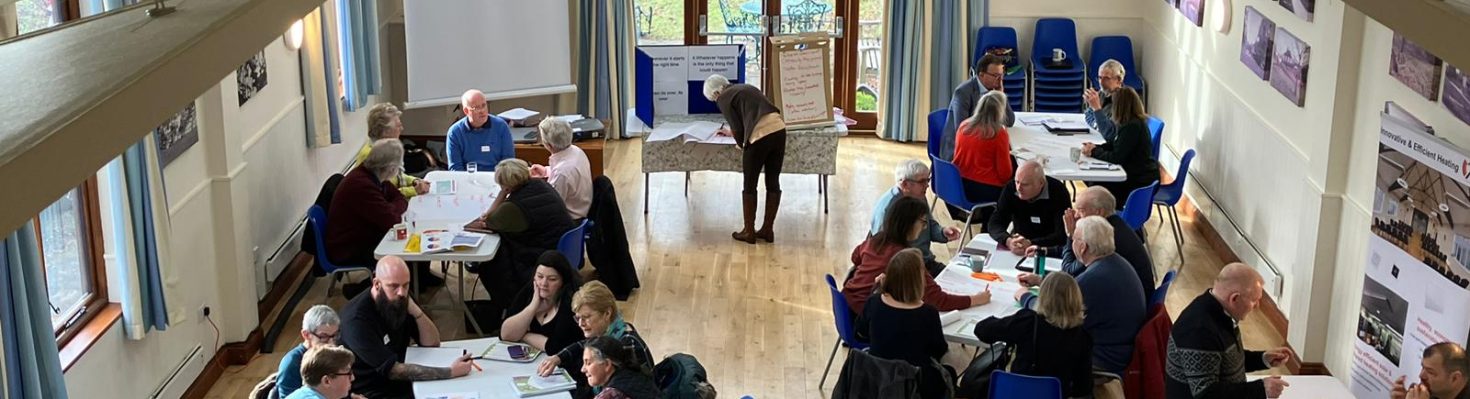
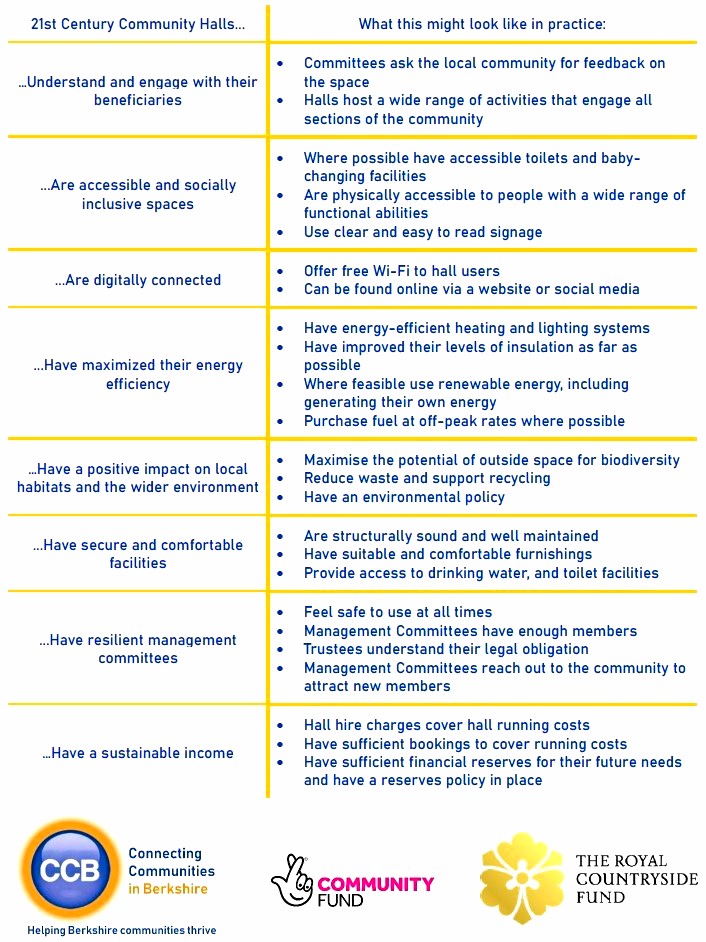
21st Century Community Halls: End of Year 2 of this five year project

The 21st Century Community Halls project has made significant progress, conducting initial consultations with halls and increasingly focusing on follow-up reviews. With the recent addition of a new Project Development Officer, David, the project has gained momentum and has introduced initiatives to address common themes shared by many halls.

The Initial Consultation: We have completed 13 further 21st Century Community Hall initial reviews during this period. Each review is completed during a visit to the facility with additional information provided before and after. The review includes over 120 questions divided into 7 parts:

  • The Building and the Organisation
  • Sustainability
  • Environment
  • The Fabric of the Building
  • Energy
  • Accessibility
  • After the consultation a comprehensive report is prepared for the Hall’s management team
    with a pack of suitable supporting information. After considering the contents, comments, and actions, we ask Trustees to draw up an action plan for the key issues they want to address. CCB then assist with advice for the resulting actions and projects that these form into.

The Follow-Up Reviews: CCB seeks a follow-up with the management committee approximately every 6 months via a call, or a visit depending on the needs of the
committee and on the activity and challenges. To date we have completed 22 formal follow-up reviews of halls we have consulted with.

Learning Partner Selection: We have now selected a Learning Partner to help us evaluate the project, and will begin working with them in January 2025.


One-to-One Support: During this period, in-depth one-to-one support has been given to halls for their development actions:

  • Providing best practices and examples for Business Planning to 15 Trustees from 14 different Village Halls in Berkshire.
  • Writing, reviewing and successfully obtaining funding from The Platinum Jubilee Fund.
  • Developing Fundraising plans with three separate committees and delivering Fundraising training around ‘evidencing need’ to 8 trustees from 6 different Village
    Halls.
  • Designing, conducting and analysing Community Consultations with three separate committees.
  • Risk review and support with one new member.
  • Supporting a member hall in updating its governing document.
  • Supporting a Village Hall to review plans for a complete rebuild in favour of a major refurbishment (due to financial restrictions and community feedback)
  • Renegotiation of a lease for one Community Hall.

    If you would like your hall to participate in the 21st Century Village Halls project, please email me. kate.meads@ccberks.org.uk and we can arrange a time for a consultation.

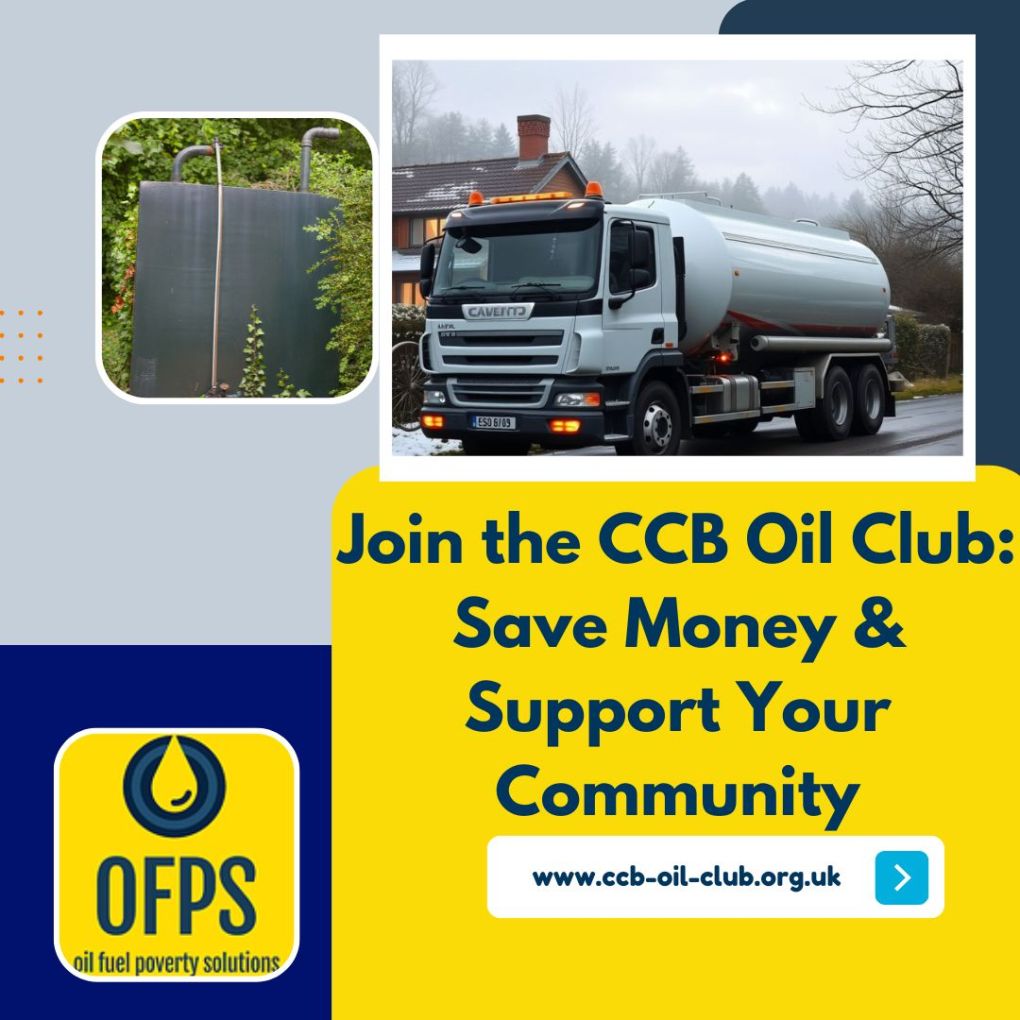
Join the CCB Oil Club: Save Money & Support Your Community

Do you live in Berkshire and heat your home with oil? If so, you’re not alone — and we have a way for you to save money while helping your community.

If you’re off the gas grid and rely on oil for heating, the CCB Oil Club can help you reduce your fuel costs through bulk purchasing. By joining forces with others in your area, you can take advantage of group buying power to secure better prices on oil deliveries — and help reduce the number of tankers on the road, too.

No Local Oil Club? We’ve Got You Covered!

For households that don’t have a local oil club, the CCB Oil Club, launched in partnership with the Oil Fuel Poverty Scheme (OFPS) in 2012, is available to all homes across Berkshire. This initiative allows every home in the county to benefit from the cost-saving advantages of group buying, regardless of their location.

Real Savings, Real Impact

In the last quarter (July – September 2024), our members collectively saved over £1,200! It’s clear that by pooling resources, we can all benefit. And with winter just around the corner, now is the perfect time to top up your oil tank before demand and prices spike.

Why Wait? Sign Up Today!

Don’t wait until the cold weather hits — join the CCB Oil Club today to ensure you’re getting the best price for your heating oil. To learn more or sign up, click here.


A Manifesto for Delivering Thriving Rural Communities Through Affordable Housing

Rural Housing Week (1st to 5th July) is an opportunity to focus on the housing challenges facing people living in rural communities.  It is a chance to highlight how we can do things differently and develop lasting solutions to the rural housing crisis which is driven by a combination of low local incomes, high housing costs due to external demand, and a limited affordable housing supply. With affordable housing constituting only 9% of villages compared to 17% in urban areas, the disparity is striking.

Workplace incomes in rural areas are lower than in urban areas, but housing costs are higher. This can mean that what is known as Affordable Rent, charged at up to 80% of market rents, is unaffordable for many. Local Housing Allowance rates are often insufficient to cover higher rural rents, leaving a gap that many rural working residents find difficult to fill.

Rural Exception Sites –  small plots of land which can only be developed for affordable housing for local people,  are often the only route to meet housing needs in rural communities. However, development on these sites has halved over the past five years. 

Rural Housing Enablers are impartial advisors from rural community organisations like Connecting Communities in Berkshire, Community Impact Bucks and Community First Oxfordshire. They play an essential role in  supporting communities, landowners, local authorities, and housing associations to deliver housing on Rural Exception Sites

A New Strategy for Thriving Rural  Communities

A Manifesto for Delivering Thriving Rural Communities Through Affordable Housing is a strategic document developed by a coalition of rural charities and housing associations. It makes several evidence-based recommendations to address the rural housing crisis, focusing on a long-term strategy for scaling up and delivering a national programme of affordable rural housebuilding. Key recommendations include:

  • Housing Needs Requiring local authorities to assess and document the specific housing needs in their rural communities and devise targeted policies and strategies to address them.
  • Enhanced Planning Policy improving national planning policy and guidance to accelerate delivery of homes through Rural Exception Sites.
  • Funding for Enablers Establishing an annual fund of approximately £2.6 million to sustain a national network of Rural Housing Enablers.
  • Adapted Homelessness Strategies Adapting homelessness and rough sleeping strategies to rural areas, focusing on prevention and using enhanced data collection to uncover hidden needs.

Affordable rural housing projects, often small in scale,  yield major benefits, contributing significantly to community investment and economic prosperity. Building just ten such homes can provide a £1.4m economic boost, support 26 local jobs, and secure a net return of around £250k for the Treasury, before considering other local multiplier effects.

By understanding and addressing these challenges, the strategy aims to make the countryside a viable, inclusive, and attractive living option, enriched with opportunities for all.

Collaboration for Impact

Connecting Communities in Berkshire, Community Impact Bucks and Community First Oxfordshire are working together under the banner of the Rural Thames Valley Partnership. By sharing knowledge and resources, we aim to get the most out of our respective rural housing projects for the rural communities we serve.


50 Ways we have Supported Communities in Berkshire in the last 50 years.

In September 1973 our charity was born at an inaugural meeting and the decision was taken to establish Berkshire Community Service Council. In 1974 a submission to Berkshire County Council for grant aid was agreed and we were able to appoint our first member of staff – a Countryside Liaison Officer. The past 50 years have seen us change office locations, CEOs, Chairs, our name, and areas of project delivery/specialism a variety of times but the heart of our work has always focused on community development and providing help, advice, and guidance to rural communities in Berkshire.

Here we will take a very brief look back at the highlights of our 50 years and what we have been most proud of achieving for the county of Royal Berkshire in this time. So, in no particular order here we go….

1. Supporting Flood Resilience in Swallowfield – working with the Swallowfield Flood Resilience Group in 2016/17 we produced and shared a guide to help communities form and operate a flood resilience group. This work, and groups like it, will be needed more and more as we operate under a climate of intense weather patterns in the next 50 years.

2. Setting up an Oil Buying Group – Over 10 years ago the CCB Oil Group was set up to help individuals who rely on heating oil (usually in our more rural areas) to access the discounts and support of a collective buying group and continues to support rural households today. In the last 5 years, we have saved our oil club members over £56,000* (*compared to standard heating oil pence per litre prices)


3. Berkshire Association of Local Council Service – For two lengthy periods over the last five decades CCB employed a Berkshire Association of Local Councils Executive Officer to provide first-class support, advice, practical help, and training to members of BALC – Berkshire’s parish and town councils.

Community Conference


4. Village Halls Conference

We have regularly run an annual Village Halls Conference offering training and workshops on relevant information to trustees, volunteers and committees that run our fantastic community buildings. Below is a montage of our previous conferences over the years.

5. Annual Conferences for Parish Plans

Our annual ‘All You Need to Know’ conferences brought together parish planning and community groups from across the county to share knowledge and experiences.

Sarah Ward, Parish Planning with Scout Cubs


6. Community Action West Berkshire

From 2003 – 2009 we ran the West Berkshire Council for Voluntary Service – providing expertise and support to volunteers alongside our rural community development work in this geographical area.

7. Trailblazing the need for affordable, green energy

Back in 2007/8 we ran two conferences in Berkshire focusing on green energy stating that ‘the era of cheap energy is behind us and the implications are still not understood by many people.’ How true that statement feels in 2024!


8. Asian Women’s Project in Thatcham

In the mid-noughties, we ran an Asian Women’s Project – open to Asian women of all backgrounds and their preschool children and aimed at providing family learning opportunities.

9. Parish Planning Throughout West Berkshire

Parish Planners may remember our fantastic connector of people Sarah Ward who worked with volunteers to give local people the chance to develop a 5-year action plan for the community. These plans covered a range of issues from transport to youth activities, safety to improvements to the local environment. During the lifetime of this project 48 Parish Plans were launched in communities from Lambourn to Beech Hill in the west of our county. This project helped ensure that our rural communities thrived and helped establish many assets that are still enjoyed in 2024 – play parks, village markets, village hall improvements, youth projects, environmental improvements and more.

Asian Women’s Project


10. Home Safety – In the Royal Borough of Windsor & Maidenhead we led a campaign to make the homes of 1,000 vulnerable residents safe and burglar proof. The project saw us working in partnership with a range of other organisations including Neighbourhood Watch Groups, Thames Valley Police, local housing associations and Age Concern.

11. Affordable Homes Built in Woolhampton – In 2015 eight affordable homes were officially opened on a rural exception site in Woolhampton (Hill Place) – affordable homes for local people in perpetuity. This was the result of eight long years of work partnering with local landowners, the borough and parish council and a social housing provider. It was all worth it though as one of the families that moved into a house highlighted at the time; “We are so thrilled to be able to return to the village that my husband grew up in. We are now surrounded by family support, friends and lovely new neighbours. The stress has gone from our lives.”


12. Cookery Courses for Dads/male carers and children – In 2010 we enlisted three top local chefs to run some tasty cookery courses over in John O’Gaunt School in Hungerford with learners going away with some new techniques, information on nutrition and menu planning on a budget.

13. Big Society – It may be a buzzword that we no longer hear so much but back in 2010 it was a key political tagline, and we are proud of running a conference attended by 100 + delegates at Reading Uni that was packed full of workshops that empowered communities and provided opportunities for us all to build our social capital.

Cookery Courses for Dad


14. Growing Community Cinemas in Berkshire – Before the age of online streaming we helped Berkshire villages and rural areas set up community cinemas in the past, some of which still run very successfully in 2024. Many are/were run in their local village hall and offered residents the chance to enjoy a movie/night out without having to commute anywhere. “The club offers local residents and those in outlying villages a chance to see popular films at an affordable price.” Photos?

15. Warm in West Berkshire – Delivered alongside key partner organisations this project in the early twenty-tens increased access to NHS health advice on staying healthy in winter, and energy efficiency with the legacy of the project seeing the launch of the CCB Oil Club and In Case of Emergency (ICED) 4×4 Drivers to help provide transport during extreme weather conditions.

16. Focused support for children and young people in the Gypsy, Roma & Traveller Community – in the mid noughties we provided basic skills training in literacy, numeracy and IT for adults and young children at two GRT sites in West Berkshire.

17. Unpaid Carers Project – We were able to engage with 1600 unpaid carers from across Berkshire and provide a wealth of opportunities to access learning and wider support which left a legacy of new community groups and organizations to continue to support programmes of activities in the county.

18. West Berkshire Vibrant Villages – Provided support for eleven communities to develop projects ranging from essential repairs and renovations to village halls to the provision of play equipment for toddlers. In total, £70,000 was awarded to our rural West Berkshire villages through the delivery of this project.

19. Berkshire Rural Towns Project – this project allowed funding to support projects in Berkshire with an economic focus many of which can still be enjoyed by our communities today – the development of the community centre in Stratfield Mortimer and the revitalization of recreation areas in Eton & Eton Wick to name a couple.

Art Classes for Unpaid Carers


20. Community Development Work – Always at the heart of our work! CCB was able to employ two Community Development Workers in the late 90’s thanks to National Lottery funding. Their work focused on supporting the most disadvantaged groups living in rural Berkshire.

21. Bringing Funding Support to Rural Areas – In the mid-90s we administered funding for the Berkshire Rural Action Network which assisted groups in rural areas to improve their environment and their community’s appreciation of it.

22. Community Care Forum – In 1994 we coordinated and administered the Berks Community Care Forum which amongst other outcomes ensured that voluntary sector representation was on the Hospital Discharge Policy Groups for both East and West Berkshire.

23. Digital Switchover – When the analogue TV signal was being switched off in 2012 it was an event that all communities in the county needed to be prepared for. With a team of community volunteers, CCB ensured that the word was spread through shopkeepers, churches, newsletters and face-to-face events at our libraries so that no one was left with a blank television.

24. Webinars – online training delivery – Before Covid made the world of online learning/meeting the norm CCB was ahead of the curve delivering regular funding workshops with the Big Lottery’s South East Awards for All Programme Manager to communities across Berkshire. In 2011-12 alone we delivered training to 160 adults piloting this new type of training delivery. “The response we received in feedback showed a very high level of appreciation for the workshops, especially with regards to the cost savings of webinar delivery.”

25. Helping Our Village Shops – In 2001 we were able to support rural retail outlets by providing free visits from an expert retail advisor to support improvements alongside helping them to apply for improvement grants. An outcome of this project was helping South Ascot Village Stores to successfully obtain a grant to combine the village shop with the post office.

26. Increasing Adult Community Learning Opportunities – Since 2010 we have delivered training opportunities for adults in West Berkshire, Bracknell Forest, Slough and Wokingham Borough. We continue to deliver these strengthening communities sessions today in West Berkshire on a variety of topics from Data Protection to Food Hygiene, from First Aid to Community Organising and many, many topics in between.

27. Seated Exercise Classes – After Covid and lockdowns affected us all mentally and physically we worked in rural communities to set up local gentle exercise and social interaction opportunities. We helped village halls set up, market, and offer these subsidized free opportunities to their local communities. We continue to support some of these classes in 2024 though many now continue without our help as they are self-sufficient and popular.

Englefield Village Hall


28. Community Buildings – Thanks to the work of our Village Hall/Community Buildings Advisors over the years we have helped support the creation of both new village halls (Englefield) and the upgrades to many village halls so that they remain vibrant, safe, and well used (recent examples Bucklebury, Beech Hill and Spencers Wood)

29. Enabling Local Orchards to Thrive – At the start of the twenty tens we successfully bid for a National Lottery Fund (at the time called Big Lottery) to establish community orchards in parishes of Twyford, Wargrave, Swallowfield, Shinfield and at Dinto Pastures. These orchards continue to flourish to this day.

30. Supporting Neighbourhood Plans in East Berkshire – In 2011 Neighbourhood Planning was introduced in the Localism Act 2011 and our Rural Housing Enabler at the time, Arlene Kersley, stepped up to immerse herself in the new framework to fully understand the evidence base required to get a neighbourhood plan through examination and stand-up to scrutiny. She shared her knowledge with groups that came forward in the Royal Borough of Windsor & Maidenhead

31. Supporting the Rural Economy in Berkshire – Our current CEO Tim has always been passionate about working with and representing the rural communities in Berkshire to identify local economic priorities. Tim has worked closely with the Thames Vallery Berkshire Local Enterprise partnership supporting rural economic development.

32. Transforming Local Infrastructure Projects – along with partners in the voluntary and community sector in West Berks we helped build capacity in the sector by delivering a programme of PTLLS (Preparing to Teach in the Lifelong Learning Sector) to 33 people helping them to develop their skills and increase their delivery activities.

33. Funding Rural Communities in Berkshire

Throughout our life as a charity we have helped fund and administer many grants including ;
• Berkshire Rural Action – funding for rural projects which help people appreciate and improve their local community.
• Countrywork – promoting employment opportunities in the countryside.
• Voluntary Sector Development Fund – to assist other voluntary organization with training or consultancy.

34. Friendship clubs – In the noughties we developed five friendships clubs in West Berks for people who had become isolated or lonely due to physical and mental health issues.

Energy bill advice to a mother and baby group in Slough


35. English Speakers of Other Languages (ESOL) Project – In 2003 we secured funding to establish an ESOL Basic Skills in the workplace project which supported 184 learners to access skills development at local colleges and in community settings.

36. Berkshire Calor Village of the Year competition – In the early noughties we helped administer and organized presentation evenings for the Village of the Year competitions. This competition was judged on ‘a well-balanced, pro-active, caring community which has made the best of local opportunities to maintain and enhance the quality of life for all residents.”

37. Fuel Poverty Outreach work – Our Fuel Poverty work has been an integral part of our project delivery for over a decade now. Outreach work has helped create new opportunities to advise low-income families on how they can reduce their home energy costs with advice drop-in sessions, one-to-one telephone advice and practitioner training workshops.

38. Country wide delivery (PHOTO IMAGE FROM 1996 below) illustrating our delivery outcomes across six local authorities.


39. Village Initiatives Fund – In 1988 we launched this fund to encourage and stimulate voluntary self-help initiatives in rural Berkshire. Grants of up to £100 were distributed to village projects that benefitted the local community – the fund was sponsored by Shell UK, Digital, Marley Roof Tiles and Newbury Building Society – except for Shell UK how many still operate today?

40. Entering the computer age – In 1988 it was such an event that we acquired a second Apricot computer we mentioned in our Annual Report! This helped us develop a variety of databases including Parish Council information, membership and mailing lists.

41. Taking care of our environment – photo from 1980’s annual review


42. Adult Community Learning partnerships – Over the years we have partnered with a number of other organisations to ensure that our training to rural communities in Berkshire is varied and useful. These included Tutors/experts from other organisations like Heartstart, Community Organisers, BALC, Royal Berks Fire & rescue, Volunteer Centre West Berkshire, Happiness Hub, Love Food Hate Waste, British Red Cross, Volunteer Centre West Berkshire, Databasix UK, social media and marketing experts, grant providers and many more! Thank you for sharing your wisdom and expertise.


43. Rural Access to Services Programme (RASP) – Between 2008 and 2011 CCB worked with other Rural Community Councils in the South East on a programme to invest in projects to improve access to services. A total of £171,000 in funding from the South East England Development Agency was invested in projects in Berkshire to improve access to healthcare, access to skills and advice, and improved community transport and accessibility projects from parish plan action plans.

44. Transport West Berkshire – In partnership with the West Berkshire Library Service, CCB raised funds to introduce the Community Learning and Information Vehicle: CLIVe. The converted lorry became a mobile hub for outreach community learning across the District, supporting our Traveler Education project, promoting the uptake of broadband internet with the Connected Berkshire Partnership and taking information on CCB’s services out into the community, including at the Newbury Show.

45. Transport East Berkshire – With funds from the Countryside Agency to increase sustainable travel, CCB implemented a project to install cycle lockers at several sites across Wokingham and West Berkshire. With a focus on railway stations, the project encouraged people to cycle and leave their bikes secured at the station.

46. West Berkshire Funding Fair at Newbury Racecourse in September 2009. We planned and delivered a variety of workshops centred on helping community groups and voluntary organisations find funding. The outcome of this successful networking day was empowering West Berkshire charities to access new funding streams for their community projects and receive information, support, and advice on fundraising for their charity/community building.

47. In 2001 CCB took over the administration of the Environmental Trust for Berkshire. The Trust oversaw a £600,000 investment in environmental projects and worked with the newly-formed Waste Recycling Environmental Ltd (WREN) to advise on applications received by this new fund for Berkshire. Projects supported by the ETB cover all six unitary authorities in Berkshire and include the renovation of churches and historical monuments, improvement of local parks, nature reserves and other amenity areas and education on recycling and sustainable waste management.

48. In 1977 our ‘Your Village – What Future’ Conference heralds a year of activity and self-help in Berkshire villages. Declining rural services and growing rural populations are recognised as an increasing issue for rural communities as Central and West Berkshire are designated growth areas for new housing. A parish survey, interviewing Parish Clerks, provides basic information on settlement in rural Berkshire.

49. In the early 80’s unemployment is a serious problem within Berkshire and CCB supported employment initiatives with Berkshire County Council. Berkshire Youth Action (now Berkshire Youth) is established and we help search out projects which can be undertaken by youth teams across Berkshire. CCB sets up the Newbury Resources Centre for the Unemployed to assist the rural unemployed get access to information and advice.

50. In the late 1990’s (1998) Berkshire County Council was no longer and our charity had to develop to reflect these changes so our delivery adapted to a project-focused approach. We launched ‘Rural Areas: People and their issues’ and a review of Youth Homelessness in ‘Young People Living in Our Community’. Seven Neighbourhood Forums are developed and new initiatives in supporting local mental health groups and users of housing association-supported accommodation begin.