Funding Opportunities in November

Neighbourhood Watch Community Grants Fund

About Us: Our focus is to help you kickstart, improve or expand your community work. The Trustees of Neighbourhood Watch Network set aside funds for this scheme.
Criteria: grants are only for registered Neighbourhood Watch members who are representatives of a registered and recognised Neighbourhood Watch scheme, group, Area or Association in England and Wales.
Funding priorities
• Tackling Antisocial Behaviour – Improving the community environment
• Increasing membership of local watches
• Addressing crime through Community Cohesion
• Tackling loneliness in our Neighbourhood Watch communities
Grant Size: Between £100 – £300. Groups can only hold one grant at a time and only hold one grant in each financial year.
Deadline for applications: 14th January 2025

Cash4Clubs Sports Funding

Applications close on Tues 12th November.
Grants of £2,000 are available for community and voluntary sport groups across the UK and Ireland, who are delivering activities for a social purpose to under-represented communities. This programme is exclusively focused on supporting adult clubs as we want to offer funding to groups that deliver activities to over 18s only, with an emphasis on 18–25 year olds. Learn more.

Bracknell Forest Household Support Fund

Applications accepted on a rolling basis.
The council will be using funding to support low income households with the rising cost of living, including energy, food and essential bills. The scheme will be enhanced to enable Bracknell Forest residents in financial hardship who would not otherwise automatically qualify for support to apply. If households are eligible, they can apply based on an existing assessment criteria which will include a financial assessment of income and assets, or cost-of-living vouchers for low-income families not eligible for school distributed vouchers.

West Berkshire Council Household Support Fund

The Household Support Fund is there to help people struggling to meet essential housing costs including energy and water bills, food, and wider essentials. There is £695,000 available which includes funding for individuals and families, as well as money set aside to provide free school meals and help for pensioners and young people leaving care.

Winter Wishes Fund

Applications close on Weds 13th November.
This fund is for grants of between £300 – £1,000 for organisations running projects that provide vital support to those most vulnerable in our communities, helping to navigate this time of year. Funding can be used in a variety of ways, from providing the local community with a warm nourishing meal, gifting toys and hampers to families in need and providing shelter to people without a safe place to call home at Christmas.

Improving Homes & Community Spaces

Applications close on Friday 15th November.
One-off grants are available to UK registered charities for projects that improve homes and communities spaces for those who are experiencing homelessness, in financial hardship, impacted by health, disability or other disadvantage or distress. We generally support with funding of up to £10K for building or indoor projects, and up to £5K for garden projects.

Nature Hubs Funding

Applications close on Fri 29th November.
Grants are available for registered organisations across to deliver projects and activities that create or enhance green spaces within 5 kilometres of a Starbucks store. Groups can apply for grants up to £6,000 to set up or enhance community-led green spaces.

Petplan Charitable Trust

Applications close on Mon 9th December.
Grants are available to support animal welfare charities and institutions to promote the health and welfare of animals across the UK. Animal assisted therapy charities will be considered, however there is a requirement to detail the current and long term welfare needs of the
animals.

The Adamson Trust

Applications close on Tues 31st December.
Grants are available for non-profit organisations and charities to help with the cost of holidays or respite breaks for disabled children, aged 3 to 17 years, with physical, mental, or emotional impairments.

Turners Court Youth Trust

Applications accepted on a rolling basis.
Grants are available for registered charities and small community groups whose work is focused on the needs of vulnerable and disaffected children and young people up to the age of 23 years in Buckinghamshire, Berkshire and Oxfordshire. Projects will be assessed as to the positive difference they will make in the areas of early life experiences, safety, wellbeing, overcoming barrier, work skills, independence and/or crime prevention.

Just Transition Fund

A total of £5 million is available in grants to charities and community energy groups across England, Scotland and Wales to develop renewable energy projects that benefit those most in need. The fund, piloted under the scheme’s Carbon Emissions Reductions priority, aims to build the capacity of the community energy sector and deliver impactful renewable energy projects. It seeks to demonstrate how a just transition to net zero can benefit everyone.
Criteria: Registered organisations, in England, Scotland and Wales, can apply for grant funding to deliver energy related projects that meet the scheme priorities.
Grant Size: The Just Transition Fund will award grants between £20,000 and £250,000 to individual projects.
Deadline for applications: 5pm, 19 November 2024

Material Focus

The Electricals Recycling Fund aims to grow existing methods or test new creative and practical ones for recycling small household electricals.
Criteria:
They fund two types of projects – those seeking to grow or develop existing household collection services for small household electricals, and those seeking to innovate new collection methods. Applications from registered organisations only – such as local authorities, waste collection authority areas, contractors, non-profits, community sector organisations, producer compliance schemes, and retailers – not individuals.
Grant Size:
Growing existing services – grants of up to £100,000 for projects that grow existing collection methods for small electricals.
Innovating new methods – grants of up to £50,000 to come up with new approaches to repair, reuse and/or recycle electricals.
Deadline for applications: Rolling basis

The Alec Dickson Trust

The Trust supports volunteering or community service projects organised and run by young people aged 30 and younger.
Criteria: For individuals or small groups of young people to help them put their ideas into action and run projects that benefit the lives of others.
The funding is for projects that:
• Support and encourage youth volunteering, particularly those that involve lots of volunteers, and encourage young people to stay engaged as volunteers in the long term.
• Have a positive impact on disadvantaged communities and individuals. Projects should identify a specific need and how to address this need. There is particular interest in projects that will have a deep and meaningful effect on those it reaches, as well as projects that are as long-lasting and sustainable as possible.
• Are innovative and try to do things differently. This could be addressing a real need for the community or doing something that has not been done before.
Grant Size: Up to £500
Deadline for applications: 13 November 2024

B&Q Foundation

About Us: The B&Q Foundation Grants programme is managed by Neighbourly, a platform used by local Good Causes across the UK and Ireland. Groups will need to create a profile on the Neighbourly platform as part of the B&Q Foundation application process.
Criteria: Grants to registered charities to provide, maintain, repair or improve housing or community space. The projects should benefit people most in need because of homelessness, financial hardship, sickness, disability or other disadvantage.
Grant Size: Up to £5,000 is available for garden projects and up to £10,000 for building or indoor projects.
Deadline for applications: 6pm on 15 November

Music 4 All

Music for All’s next funding round of 2024 is NOW OPEN to applicants!
See their website for full details on our upcoming community funding opportunities.
Please read the eligibility criteria and instructions carefully before applying.
Funding round 4 will close on the 13th of January.

Comic Relief Community Fund

Grants of up to £5,000 are available and offered on a flexible basis, depending on need.

Funding can be used on core organisation costs, direct project related costs or a combination of both that support your organisation to deliver against any of the four areas.

An example of core funding could be a contribution to organisation’s annual budget to continue its good work, funding to expand the work, or to add something new that amplifies results. It could also be allocated for expenses that are harder to fund, such as salaries of senior management or administration, or ongoing costs that are not covered by other grants.

Thank you to Volunteer Centre West Berkshire, Wokingham & Bracknell InVOLve and Slough CVS for the information contained in this article.


Funding Opportunities in September

Austin & Hope Pilkington Trust

Applications close on Mon 30th September.
We are committed to awarding grants to those most in need. For this round of funding, we are focusing on projects which provide food education and/or cooking skills. The maximum amount available is £5,000. To be eligible to apply you must be a registered charity with an income and expenditure which meets our requirements and your project must not be on the list of what we don’t fund. Only one application form per charity will be considered.

Christmas Connections Funding

Applications close on Friday 11th October.
Grants of up to £750 are available for small charities and community groups bringing together people over 65 at Christmas. These grants are for organisations connecting older people between 9th December until 2nd January. Priority will be given to organisations working in deprived areas and where activities are taking place over the Christmas holiday period. Please review the grant guidance before applying. Examples of activities funded include the provision of a meal on Christmas Day, group social events, and/or support for day centres providing services over the festive period, etc.

Local Nature Grants

Applications close on Tues 24th October.
This scheme is designed to provide young people with an opportunity to take the lead on projects that involve their local nature and natural spaces, to aid young people in realising their influence to affect positive change, to have their voices heard, and see their ideas come to life. We therefore fund innovative projects that are designed and led by young people in the UK. Adult applicants should develop their proposal alongside young people and the projects should seek to empower local young people to enact changes they want to see, such as increasing access to natural spaces and improving understanding of their local biodiversity. This grant is purposefully broad and welcomes novel ideas, with a maximum award of £1,000 per proposal.

The Naturesave Trust

Applications close Thurs 31st October.
Our funding focuses on small environmental projects for charities, social enterprises and grassroots community groups whose activities are based within the UK. The theme of this funding window is energy efficiency. We are looking for grant applications up to £5,000 from organisations who are working to promote a more sustainable approach to energy efficiency through insulation, solar panels, lighting initiatives, cooking solutions, new equipment, energy audits, heating projects, workshops, etc.

Barchesters Charitable Foundation

Applications are accepted on a rolling basis. Our funding focus is on connecting or re-connecting people with others in their local community. We support applications that combat loneliness and enable people to be active and engaged. We help small community groups and local charities with activity projects, equipment/materials for use by members, member transport, and/or day trips, outings, activities/group holidays in the UK. Our grants for groups range from £100 up to £2,000.

The Earley Charity – Capital Projects Programme

30 September 2024. The Earley Charity’s Capital Projects Programme has reopened for a second round of funding. By Capital we mean bricks and mortar such as new builds, extensions and large-scale refurbishments. The programme has a budget of £105,000 and is open to local organisations that work in or predominately serve the Earley Charity’s area of benefit. The Trustees intend to support several projects through the programme and are happy to accept bids for either full or part funding. They are particularly interested to hear from organisations that have not received funding from the Earley Charity before.

Eligibility criteria: In the first instance Trustees are seeking Expressions of Interest from local organisations that have well-developed plans for a distinctive capital project which may be supported through this programme.

To be eligible you must be able to demonstrate the following:

  • your organisation works in or predominantly serves the Earley Charity’s area of benefit*;
  • you have confirmed planning permissions in place;
  • your project is due to start and/or complete between now and the end of 2025.

Area of Benefit: In practice, this means all of Earley (Lower Earley and “old Earley”), the northern part of Shinfield, Winnersh, south Reading (including Whitley), east Reading (including Newtown), central Reading (as far west as the Reading West railway line), Sonning and lower Caversham. Please see our website for a detailed map http://www.earleycharity.org.uk/Map.aspx

The Wakeham Trust

We usually make VERY SMALL grants to VERY SMALL projects. We don’t have formal grant criteria, but we are normally looking for leverage (in the sense that we make small contributions to projects nobody else will touch, in the hope that they can sometimes turn into something big).

So about 50 years ago we started backing pregnancy advisory services, women’s shelters and rape crisis centres, because they were new and unpopular with other funders (indeed, we had a run-in with the Charity Commission at that stage, which did not like pregnancy advisory services); now, we seldom back them, because they have become mainstream. If things are new in a particular area then they can still meet our criteria – a lot of community action is intensely local, and the fact that something has been done elsewhere does not mean it is well-established in the places that apply to us.


Some projects that were mainstream back then have become unpopular with big funders right now – often because they can’t tick the right number of boxes (in terms of criteria like diversity and or impact statements). These criteria can make sense when evaluating big organisations, but they can be impossible for small ones to meet. So we also try to fill that gap.
Our original objective when the Trust was set ups to help projects that encourage Community Service by young people to their own neighbourhoods (along the lines pioneered by Dr Alec Dickson, who founded Community Service Volunteers).

In 2023 we are still supporting many of the same sorts of micro-scale community projects, though we have added education (in its broadest sense) to our list of priorities. Our core goal is to help small groups of people who are getting together to make a difference for others. We don’t support self-help groups, however useful they are to their members.
Where we do make quite large grants, mostly in the field of education, we usually seek to get match-funding from other organisations, so that our grants can release much bigger funding streams than we could provide by ourselves. Our goal when we support education projects is to support excellence in teaching – at all levels, from universities to primary schools. We focus on things that can give students a broader experience – getting away from the examination treadmill.

We normally give grants to projects where an initial £125 to £2,500 can make a real difference. In general, we look at what it is costing per-head to reach the people the project is helping.

W.G. Edwards Charitable Foundation

Registered charities, from large institutions to small community-run organisations, providing care for older people (65+ years) in the UK. Capital projects, refurbishment and for equipment, in addition to innovative schemes for ongoing care and projects, such as IT for the elderly, fitness classes, lunch clubs, gardening projects, etc. Grants £1000 to £3000. Deadlines 10 Mar, 10 Jun, 10 Sep and 10 Dec. Spend in year ending Apr 23 was £130k.

Awards for All

About Us: The National Lottery Awards for All England programme supports amazing community-led projects.
Criteria: They can fund projects that’ll do at least one of these things:
• bring people together to build strong relationships in and across communities
• improve the places and spaces that matter to communities
• help more people to reach their potential, by supporting them at the earliest possible stage
• support people, communities and organisations facing more demands and challenges because of the cost-of-living crisis.
Grant Size: £300 to £20,000, for up to two years
Deadline for applications: Ongoing. Apply at least 16 weeks before you want to start the activities or spend any of the money.

Thank you to Volunteer Centre West Berkshire, Wokingham & Bracknell InVOLve, Slough CVS & Reading Voluntary Action for the information contained in this article.


Meet our newest team member!

David Jennings joined our team at the beginning of the month (July 24) as our new Project Development Officer (taking over from Maria who recently switched roles to Rural Housing Enabler).

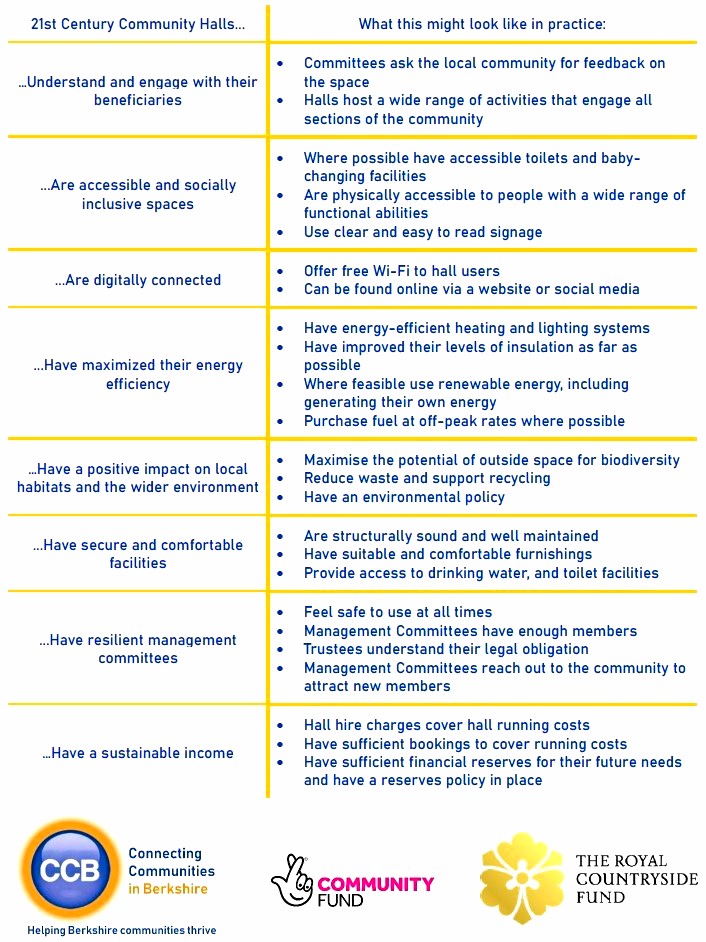
David’s work will focus on developing new projects and initiatives that support implementing action plans created through the 21st Century Community Halls programme. Here we ask David to introduce himself and tell us more about his background.

Can you tell us what made you interested in the role of Project Development Officer at CCB?

I admire the purpose of CCB to inspire community action and to deliver projects and services to improve rural health and wellbeing, reduce rural poverty and disadvantage and increase rural digital inclusion and social connectedness. I am already one of the recipients of these as a member of CCB for both Chaddleworth and Great Shefford village halls. As a customer, I have benefited from the 21st Century Community Halls programme so I was excited to be able to use my own professional skills to support and develop the project for CCB.

What are you hoping to achieve in your first six months in the post?
That’s what I’m working out at the moment…only in day three of the role!

What are you most excited about in your new position?
I am passionate about improving quality in local Berkshire communities: to improve our communication, resolve the issues we are facing, increase our collaboration and to get stuff done.

What do you enjoying doing outside of work?
I like to walk the dog, cycle and garden. I have also recently started paragliding again. I am a trustee for four Berkshire charities as their treasurer (Chaddleworth Village Hall, GreatShefford Village Hall, Chaddleworth and Shefford Schools PTFA, The Bakers Trustcovering fuel poverty), I edit the Chaddleworth News parish newsletter and I am the Clerk and Responsible Finance Office for Chaddleworth Parish Council.

If you could have any superpower, what would it be and why?
I would like to provoke and reward people’s empathy towards each other and for our ‘pale blue dot’ (Carl Sagan). ‘When we have the wisdom to use mercy and compassion instead of force…we human creatures will finally be on the right path’ (Leslie Thompkins, DC Comics).


A Manifesto for Delivering Thriving Rural Communities Through Affordable Housing

Rural Housing Week (1st to 5th July) is an opportunity to focus on the housing challenges facing people living in rural communities.  It is a chance to highlight how we can do things differently and develop lasting solutions to the rural housing crisis which is driven by a combination of low local incomes, high housing costs due to external demand, and a limited affordable housing supply. With affordable housing constituting only 9% of villages compared to 17% in urban areas, the disparity is striking.

Workplace incomes in rural areas are lower than in urban areas, but housing costs are higher. This can mean that what is known as Affordable Rent, charged at up to 80% of market rents, is unaffordable for many. Local Housing Allowance rates are often insufficient to cover higher rural rents, leaving a gap that many rural working residents find difficult to fill.

Rural Exception Sites –  small plots of land which can only be developed for affordable housing for local people,  are often the only route to meet housing needs in rural communities. However, development on these sites has halved over the past five years. 

Rural Housing Enablers are impartial advisors from rural community organisations like Connecting Communities in Berkshire, Community Impact Bucks and Community First Oxfordshire. They play an essential role in  supporting communities, landowners, local authorities, and housing associations to deliver housing on Rural Exception Sites

A New Strategy for Thriving Rural  Communities

A Manifesto for Delivering Thriving Rural Communities Through Affordable Housing is a strategic document developed by a coalition of rural charities and housing associations. It makes several evidence-based recommendations to address the rural housing crisis, focusing on a long-term strategy for scaling up and delivering a national programme of affordable rural housebuilding. Key recommendations include:

  • Housing Needs Requiring local authorities to assess and document the specific housing needs in their rural communities and devise targeted policies and strategies to address them.
  • Enhanced Planning Policy improving national planning policy and guidance to accelerate delivery of homes through Rural Exception Sites.
  • Funding for Enablers Establishing an annual fund of approximately £2.6 million to sustain a national network of Rural Housing Enablers.
  • Adapted Homelessness Strategies Adapting homelessness and rough sleeping strategies to rural areas, focusing on prevention and using enhanced data collection to uncover hidden needs.

Affordable rural housing projects, often small in scale,  yield major benefits, contributing significantly to community investment and economic prosperity. Building just ten such homes can provide a £1.4m economic boost, support 26 local jobs, and secure a net return of around £250k for the Treasury, before considering other local multiplier effects.

By understanding and addressing these challenges, the strategy aims to make the countryside a viable, inclusive, and attractive living option, enriched with opportunities for all.

Collaboration for Impact

Connecting Communities in Berkshire, Community Impact Bucks and Community First Oxfordshire are working together under the banner of the Rural Thames Valley Partnership. By sharing knowledge and resources, we aim to get the most out of our respective rural housing projects for the rural communities we serve.


50 Ways we have Supported Communities in Berkshire in the last 50 years.

In September 1973 our charity was born at an inaugural meeting and the decision was taken to establish Berkshire Community Service Council. In 1974 a submission to Berkshire County Council for grant aid was agreed and we were able to appoint our first member of staff – a Countryside Liaison Officer. The past 50 years have seen us change office locations, CEOs, Chairs, our name, and areas of project delivery/specialism a variety of times but the heart of our work has always focused on community development and providing help, advice, and guidance to rural communities in Berkshire.

Here we will take a very brief look back at the highlights of our 50 years and what we have been most proud of achieving for the county of Royal Berkshire in this time. So, in no particular order here we go….

1. Supporting Flood Resilience in Swallowfield – working with the Swallowfield Flood Resilience Group in 2016/17 we produced and shared a guide to help communities form and operate a flood resilience group. This work, and groups like it, will be needed more and more as we operate under a climate of intense weather patterns in the next 50 years.

2. Setting up an Oil Buying Group – Over 10 years ago the CCB Oil Group was set up to help individuals who rely on heating oil (usually in our more rural areas) to access the discounts and support of a collective buying group and continues to support rural households today. In the last 5 years, we have saved our oil club members over £56,000* (*compared to standard heating oil pence per litre prices)


3. Berkshire Association of Local Council Service – For two lengthy periods over the last five decades CCB employed a Berkshire Association of Local Councils Executive Officer to provide first-class support, advice, practical help, and training to members of BALC – Berkshire’s parish and town councils.

Community Conference


4. Village Halls Conference

We have regularly run an annual Village Halls Conference offering training and workshops on relevant information to trustees, volunteers and committees that run our fantastic community buildings. Below is a montage of our previous conferences over the years.

5. Annual Conferences for Parish Plans

Our annual ‘All You Need to Know’ conferences brought together parish planning and community groups from across the county to share knowledge and experiences.

Sarah Ward, Parish Planning with Scout Cubs


6. Community Action West Berkshire

From 2003 – 2009 we ran the West Berkshire Council for Voluntary Service – providing expertise and support to volunteers alongside our rural community development work in this geographical area.

7. Trailblazing the need for affordable, green energy

Back in 2007/8 we ran two conferences in Berkshire focusing on green energy stating that ‘the era of cheap energy is behind us and the implications are still not understood by many people.’ How true that statement feels in 2024!


8. Asian Women’s Project in Thatcham

In the mid-noughties, we ran an Asian Women’s Project – open to Asian women of all backgrounds and their preschool children and aimed at providing family learning opportunities.

9. Parish Planning Throughout West Berkshire

Parish Planners may remember our fantastic connector of people Sarah Ward who worked with volunteers to give local people the chance to develop a 5-year action plan for the community. These plans covered a range of issues from transport to youth activities, safety to improvements to the local environment. During the lifetime of this project 48 Parish Plans were launched in communities from Lambourn to Beech Hill in the west of our county. This project helped ensure that our rural communities thrived and helped establish many assets that are still enjoyed in 2024 – play parks, village markets, village hall improvements, youth projects, environmental improvements and more.

Asian Women’s Project


10. Home Safety – In the Royal Borough of Windsor & Maidenhead we led a campaign to make the homes of 1,000 vulnerable residents safe and burglar proof. The project saw us working in partnership with a range of other organisations including Neighbourhood Watch Groups, Thames Valley Police, local housing associations and Age Concern.

11. Affordable Homes Built in Woolhampton – In 2015 eight affordable homes were officially opened on a rural exception site in Woolhampton (Hill Place) – affordable homes for local people in perpetuity. This was the result of eight long years of work partnering with local landowners, the borough and parish council and a social housing provider. It was all worth it though as one of the families that moved into a house highlighted at the time; “We are so thrilled to be able to return to the village that my husband grew up in. We are now surrounded by family support, friends and lovely new neighbours. The stress has gone from our lives.”


12. Cookery Courses for Dads/male carers and children – In 2010 we enlisted three top local chefs to run some tasty cookery courses over in John O’Gaunt School in Hungerford with learners going away with some new techniques, information on nutrition and menu planning on a budget.

13. Big Society – It may be a buzzword that we no longer hear so much but back in 2010 it was a key political tagline, and we are proud of running a conference attended by 100 + delegates at Reading Uni that was packed full of workshops that empowered communities and provided opportunities for us all to build our social capital.

Cookery Courses for Dad


14. Growing Community Cinemas in Berkshire – Before the age of online streaming we helped Berkshire villages and rural areas set up community cinemas in the past, some of which still run very successfully in 2024. Many are/were run in their local village hall and offered residents the chance to enjoy a movie/night out without having to commute anywhere. “The club offers local residents and those in outlying villages a chance to see popular films at an affordable price.” Photos?

15. Warm in West Berkshire – Delivered alongside key partner organisations this project in the early twenty-tens increased access to NHS health advice on staying healthy in winter, and energy efficiency with the legacy of the project seeing the launch of the CCB Oil Club and In Case of Emergency (ICED) 4×4 Drivers to help provide transport during extreme weather conditions.

16. Focused support for children and young people in the Gypsy, Roma & Traveller Community – in the mid noughties we provided basic skills training in literacy, numeracy and IT for adults and young children at two GRT sites in West Berkshire.

17. Unpaid Carers Project – We were able to engage with 1600 unpaid carers from across Berkshire and provide a wealth of opportunities to access learning and wider support which left a legacy of new community groups and organizations to continue to support programmes of activities in the county.

18. West Berkshire Vibrant Villages – Provided support for eleven communities to develop projects ranging from essential repairs and renovations to village halls to the provision of play equipment for toddlers. In total, £70,000 was awarded to our rural West Berkshire villages through the delivery of this project.

19. Berkshire Rural Towns Project – this project allowed funding to support projects in Berkshire with an economic focus many of which can still be enjoyed by our communities today – the development of the community centre in Stratfield Mortimer and the revitalization of recreation areas in Eton & Eton Wick to name a couple.

Art Classes for Unpaid Carers


20. Community Development Work – Always at the heart of our work! CCB was able to employ two Community Development Workers in the late 90’s thanks to National Lottery funding. Their work focused on supporting the most disadvantaged groups living in rural Berkshire.

21. Bringing Funding Support to Rural Areas – In the mid-90s we administered funding for the Berkshire Rural Action Network which assisted groups in rural areas to improve their environment and their community’s appreciation of it.

22. Community Care Forum – In 1994 we coordinated and administered the Berks Community Care Forum which amongst other outcomes ensured that voluntary sector representation was on the Hospital Discharge Policy Groups for both East and West Berkshire.

23. Digital Switchover – When the analogue TV signal was being switched off in 2012 it was an event that all communities in the county needed to be prepared for. With a team of community volunteers, CCB ensured that the word was spread through shopkeepers, churches, newsletters and face-to-face events at our libraries so that no one was left with a blank television.

24. Webinars – online training delivery – Before Covid made the world of online learning/meeting the norm CCB was ahead of the curve delivering regular funding workshops with the Big Lottery’s South East Awards for All Programme Manager to communities across Berkshire. In 2011-12 alone we delivered training to 160 adults piloting this new type of training delivery. “The response we received in feedback showed a very high level of appreciation for the workshops, especially with regards to the cost savings of webinar delivery.”

25. Helping Our Village Shops – In 2001 we were able to support rural retail outlets by providing free visits from an expert retail advisor to support improvements alongside helping them to apply for improvement grants. An outcome of this project was helping South Ascot Village Stores to successfully obtain a grant to combine the village shop with the post office.

26. Increasing Adult Community Learning Opportunities – Since 2010 we have delivered training opportunities for adults in West Berkshire, Bracknell Forest, Slough and Wokingham Borough. We continue to deliver these strengthening communities sessions today in West Berkshire on a variety of topics from Data Protection to Food Hygiene, from First Aid to Community Organising and many, many topics in between.

27. Seated Exercise Classes – After Covid and lockdowns affected us all mentally and physically we worked in rural communities to set up local gentle exercise and social interaction opportunities. We helped village halls set up, market, and offer these subsidized free opportunities to their local communities. We continue to support some of these classes in 2024 though many now continue without our help as they are self-sufficient and popular.

Englefield Village Hall


28. Community Buildings – Thanks to the work of our Village Hall/Community Buildings Advisors over the years we have helped support the creation of both new village halls (Englefield) and the upgrades to many village halls so that they remain vibrant, safe, and well used (recent examples Bucklebury, Beech Hill and Spencers Wood)

29. Enabling Local Orchards to Thrive – At the start of the twenty tens we successfully bid for a National Lottery Fund (at the time called Big Lottery) to establish community orchards in parishes of Twyford, Wargrave, Swallowfield, Shinfield and at Dinto Pastures. These orchards continue to flourish to this day.

30. Supporting Neighbourhood Plans in East Berkshire – In 2011 Neighbourhood Planning was introduced in the Localism Act 2011 and our Rural Housing Enabler at the time, Arlene Kersley, stepped up to immerse herself in the new framework to fully understand the evidence base required to get a neighbourhood plan through examination and stand-up to scrutiny. She shared her knowledge with groups that came forward in the Royal Borough of Windsor & Maidenhead

31. Supporting the Rural Economy in Berkshire – Our current CEO Tim has always been passionate about working with and representing the rural communities in Berkshire to identify local economic priorities. Tim has worked closely with the Thames Vallery Berkshire Local Enterprise partnership supporting rural economic development.

32. Transforming Local Infrastructure Projects – along with partners in the voluntary and community sector in West Berks we helped build capacity in the sector by delivering a programme of PTLLS (Preparing to Teach in the Lifelong Learning Sector) to 33 people helping them to develop their skills and increase their delivery activities.

33. Funding Rural Communities in Berkshire

Throughout our life as a charity we have helped fund and administer many grants including ;
• Berkshire Rural Action – funding for rural projects which help people appreciate and improve their local community.
• Countrywork – promoting employment opportunities in the countryside.
• Voluntary Sector Development Fund – to assist other voluntary organization with training or consultancy.

34. Friendship clubs – In the noughties we developed five friendships clubs in West Berks for people who had become isolated or lonely due to physical and mental health issues.

Energy bill advice to a mother and baby group in Slough


35. English Speakers of Other Languages (ESOL) Project – In 2003 we secured funding to establish an ESOL Basic Skills in the workplace project which supported 184 learners to access skills development at local colleges and in community settings.

36. Berkshire Calor Village of the Year competition – In the early noughties we helped administer and organized presentation evenings for the Village of the Year competitions. This competition was judged on ‘a well-balanced, pro-active, caring community which has made the best of local opportunities to maintain and enhance the quality of life for all residents.”

37. Fuel Poverty Outreach work – Our Fuel Poverty work has been an integral part of our project delivery for over a decade now. Outreach work has helped create new opportunities to advise low-income families on how they can reduce their home energy costs with advice drop-in sessions, one-to-one telephone advice and practitioner training workshops.

38. Country wide delivery (PHOTO IMAGE FROM 1996 below) illustrating our delivery outcomes across six local authorities.


39. Village Initiatives Fund – In 1988 we launched this fund to encourage and stimulate voluntary self-help initiatives in rural Berkshire. Grants of up to £100 were distributed to village projects that benefitted the local community – the fund was sponsored by Shell UK, Digital, Marley Roof Tiles and Newbury Building Society – except for Shell UK how many still operate today?

40. Entering the computer age – In 1988 it was such an event that we acquired a second Apricot computer we mentioned in our Annual Report! This helped us develop a variety of databases including Parish Council information, membership and mailing lists.

41. Taking care of our environment – photo from 1980’s annual review


42. Adult Community Learning partnerships – Over the years we have partnered with a number of other organisations to ensure that our training to rural communities in Berkshire is varied and useful. These included Tutors/experts from other organisations like Heartstart, Community Organisers, BALC, Royal Berks Fire & rescue, Volunteer Centre West Berkshire, Happiness Hub, Love Food Hate Waste, British Red Cross, Volunteer Centre West Berkshire, Databasix UK, social media and marketing experts, grant providers and many more! Thank you for sharing your wisdom and expertise.


43. Rural Access to Services Programme (RASP) – Between 2008 and 2011 CCB worked with other Rural Community Councils in the South East on a programme to invest in projects to improve access to services. A total of £171,000 in funding from the South East England Development Agency was invested in projects in Berkshire to improve access to healthcare, access to skills and advice, and improved community transport and accessibility projects from parish plan action plans.

44. Transport West Berkshire – In partnership with the West Berkshire Library Service, CCB raised funds to introduce the Community Learning and Information Vehicle: CLIVe. The converted lorry became a mobile hub for outreach community learning across the District, supporting our Traveler Education project, promoting the uptake of broadband internet with the Connected Berkshire Partnership and taking information on CCB’s services out into the community, including at the Newbury Show.

45. Transport East Berkshire – With funds from the Countryside Agency to increase sustainable travel, CCB implemented a project to install cycle lockers at several sites across Wokingham and West Berkshire. With a focus on railway stations, the project encouraged people to cycle and leave their bikes secured at the station.

46. West Berkshire Funding Fair at Newbury Racecourse in September 2009. We planned and delivered a variety of workshops centred on helping community groups and voluntary organisations find funding. The outcome of this successful networking day was empowering West Berkshire charities to access new funding streams for their community projects and receive information, support, and advice on fundraising for their charity/community building.

47. In 2001 CCB took over the administration of the Environmental Trust for Berkshire. The Trust oversaw a £600,000 investment in environmental projects and worked with the newly-formed Waste Recycling Environmental Ltd (WREN) to advise on applications received by this new fund for Berkshire. Projects supported by the ETB cover all six unitary authorities in Berkshire and include the renovation of churches and historical monuments, improvement of local parks, nature reserves and other amenity areas and education on recycling and sustainable waste management.

48. In 1977 our ‘Your Village – What Future’ Conference heralds a year of activity and self-help in Berkshire villages. Declining rural services and growing rural populations are recognised as an increasing issue for rural communities as Central and West Berkshire are designated growth areas for new housing. A parish survey, interviewing Parish Clerks, provides basic information on settlement in rural Berkshire.

49. In the early 80’s unemployment is a serious problem within Berkshire and CCB supported employment initiatives with Berkshire County Council. Berkshire Youth Action (now Berkshire Youth) is established and we help search out projects which can be undertaken by youth teams across Berkshire. CCB sets up the Newbury Resources Centre for the Unemployed to assist the rural unemployed get access to information and advice.

50. In the late 1990’s (1998) Berkshire County Council was no longer and our charity had to develop to reflect these changes so our delivery adapted to a project-focused approach. We launched ‘Rural Areas: People and their issues’ and a review of Youth Homelessness in ‘Young People Living in Our Community’. Seven Neighbourhood Forums are developed and new initiatives in supporting local mental health groups and users of housing association-supported accommodation begin.