Affordable Rural Housing Project

 by Maria Kelly, Rural Housing Enabler

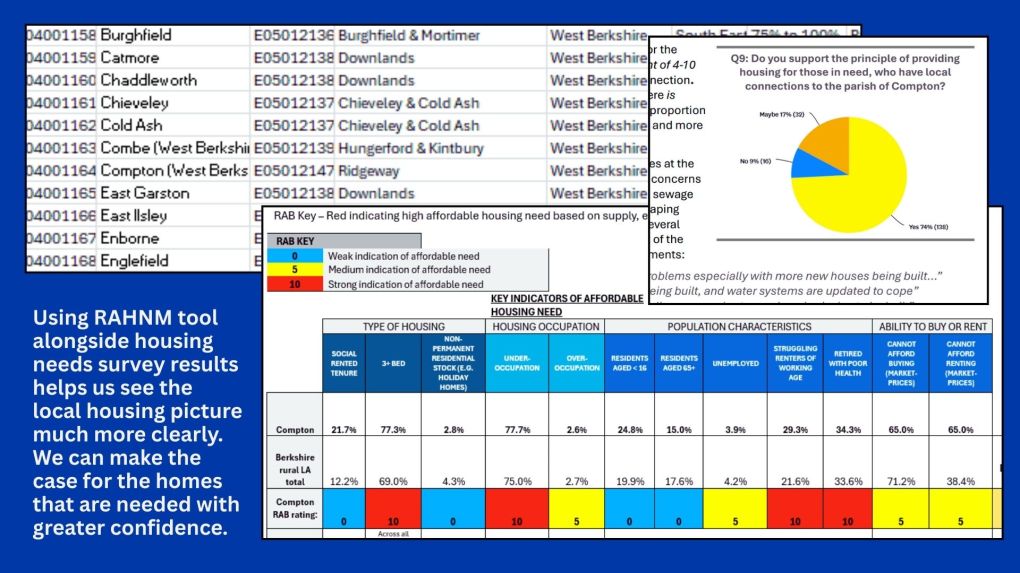
We are delighted to be able to begin using a brand-new data tool to help us identify and understand affordable rural housing need in Berkshire parishes.  The Rural Affordable Housing Needs Model tool (RAHNM for short) was created for us by Arc4 Housing Consultancy . The tool draws on 2021 census data and live housing register data – completely anonymised –  to model supply and demand, and type of homes and information about those groups most likely to be in need in a given parish.  This data can be used alongside a Housing Need Survey and beforehand, to identify where we need to focus our work.

The RAHNM tool has been used to report to the Government on rural affordable housing need across England. It is being used successfully in Durham where Rural Housing Enablers there are able to create simple reports to show parish councils what the housing need is likely to be in their parish.   Rural Housing services in Oxfordshire and Buckinghamshire are currently working on RAHNMs for their respective areas.

We are still gathering housing data from five Local Authorities in Berkshire, but we can already use the census data to build a picture of need in Berkshire Parishes. We recently shared some of this data with Compton Parish Council, and it was clear that it supported what their recent housing need survey found as well as providing additional information.

Later this Autumn, once we have received the relevant housing data from our Local Authority Partners, we will hold a launch and information event for parish councils, local authority officers and councillors, and anyone else with a stake and an interest in affordable Rural Housing. Watch this space!

Want to know more? Contact Maria.Kelly@ccberks.org.uk


#RuralHousingWeek Spotlight: Meet Maria Kelly, Our Rural Housing Enabler

As part of #RuralHousingWeek, we’re shining a light on the vital work being done to support Berkshire’s rural communities—and the people behind it. Meet Maria Kelly, our dedicated Rural Housing Enabler, who is helping to tackle the growing challenge of affordable housing in the countryside.

Building Momentum in Year Two

In March 2025, we entered the second year of our Affordable Rural Housing project, building on the successes and lessons of our first year. After nearly seven years without dedicated support for rural affordable housing in Berkshire, there was a clear need to re-establish connections with parish councils, raise awareness of the service, and understand the scale of the housing crisis in rural areas.

Thanks to strong local engagement—and support from figures such as Olivia Bailey, MP for Reading West and Mid Berkshire, who highlighted our work in a Westminster Hall debate—the project is gaining real momentum.

Maria Kelly says:
“The housing crisis is hitting rural areas hard. Too often, affordable homes go to those with no local connection—leaving communities feeling overlooked. We’re working to change that.”

Working with Rural Parishes

Since April 2024, Maria has worked closely with five rural parishes to identify local housing needs:

  • Beech Hill
  • Beenham
  • Compton
  • Waltham St Lawrence
  • Horton

Each parish faces unique challenges, but common themes include limited land availabilitypressure on housing waiting lists, and a strong desire for homes that meet local needs. In several areas, we are now exploring potential sites and housing providers for rural exception site developments—small-scale, locally driven housing projects that prioritise people with a connection to the parish.

Looking Ahead: Priorities for 2025

As we continue our work, our key priorities for the year include:

  • Continuing Housing Needs Surveys and supporting parishes progressing toward affordable housing
  • Using census data to map housing need across Berkshire and identify areas of greatest need
  • Sharing insights with parish councils to inform local decision-making
  • Advocating for local connection policies on new and existing rural affordable homes
  • Gathering feedback from tenants on Berkshire RES sites to understand the impact of our work
  • Collaborating regionally through the Rural Thames network to improve access to affordable rural housing

Get Involved

We believe that stronger rural communities start with secure, affordable homes. If you’re part of a parish council or community group and want to explore how we can support your area, we’d love to hear from you. Email Maria.Kelly@ccberks.org.uk

📍 Learn more about our work:
👉 ccberks.org.uk/our-projects/rural-affordable-housing


Building Futures: Spotlight on Rural Housing at National Conference

Connecting Communities in Berkshire joins national call to action for affordable rural homes

We were proud to take part in the recent Rural Housing Conference, held on 30 April 2025 at the historic Coram campus in London. Organised by English Rural and Action with Communities in Rural England (ACRE), the event gathered policymakers, housing professionals, and community advocates to confront the urgent and growing crisis in rural housing.

Attending on behalf of CCB was Rural Housing Enabler Maria Kelly, who joined others in championing the importance of truly affordable homes for rural communities.

The conference, titled Affordable Rural Housing: Opportunity in Changing Times, was marked by a keynote address from HRH The Princess Royal. She offered a powerful reminder that rural housing is about more than buildings:

“We aren’t just talking about houses — we’re talking about the people and communities that make our countryside live and breathe.”

The day laid bare the depth of the challenge facing rural areas:

  • The average rural house price has reached £418,400, compared to average rural earnings of just £25,600.
  • Only 10% of new affordable homes are built in rural areas, though these areas are home to 18% of the population.
  • Investing in rural housing could unlock as much as £87 billion a year in productivity, while strengthening local economies and jobs.

Speakers from across sectors—including planning, faith groups, and economic development—urged a coordinated national effort. Solutions discussed included planning reform, incentives for landowners, and sustained funding for Rural Housing Enabler programmes.

Photo by Matt Pereira Photography / English Rural

Maria said: “What really struck me was how deeply rural housing is tied to community life. Affordable homes mean local families can stay close, young people can build their futures, and essential services can survive. There’s a real opportunity now to make lasting change, and I left the conference energised and hopeful about what we can achieve together.”

Dame Fiona Reynolds captured the overarching theme of the day:

“This is about building more than homes. It’s about building futures.”


Affordable Housing Initiative in Beenham

Since April our Rural Housing Enabler Maria has been working with Beenham Parish Council to help them identify affordable housing need in Beenham and look at options for developing affordable homes for local people in the Parish.

A Housing Needs Survey was completed in September 2024, and the results were presented to Beenham residents at a public meeting on the 29th October at the Victory Hall. This meeting was also an opportunity for residents to share stories about the impact of insufficient affordable housing in the village on individuals and the community as a whole, and ask questions about what happens next, once housing need has been identified.

David Hancock, Parish Councillor, described succinctly how the cost of housing was affecting the community. He said:

“As young adults having families, many of us had the benefit of becoming house owners or having affordable rents because property prices were cheaper relevant to income. In Beenham today the cheapest house is 7 times annual income. Previously, we were able to choose where we lived, so we were able to grow up with family near us in a community we knew, if we wanted to. Communities could sustain local schools and some amenities. As people moved on from running the community’s clubs and associations we had their successors, young people rooted in the community. Today that is being lost in Beenham. We can change this and that is why we started this initiative with the full backing of the Parish Council and the indispensable support of CCB.”

Acting Headmistress of the local school, Sophie McBean, made a statement about the problems facing the school due a to lack of accordable homes in the parish:

“Beenham has very little housing that is affordable for young families. When applying for school places, families fall in the catchment of the school they live closest to, so making the village more accessible for young families will help to increase pupil numbers in the school. Pupil numbers are vital for every school but make a particular impact on small schools such as Beenham Primary School. School funding is allocated per child, so in simple terms, the more children in school equates to more money to spend on providing an excellent education for all of our pupils.”

With around 50 people in attendance there was lively discussion about housing issues and potential sites for new homes, and with a wide range of views in the community about new developments, past housing initiatives, infrastructure, and the importance of local connections criteria, the Parish Council did an excellent job of allowing everyone to speak and be heard.

As affordable housing need HAS been identified in Beenham, the next step will be to visit potential locations for homes with a local planning officer to assess site viability and start to approach relevant landowners. As with any community, there will be supporters and those with concerns or objections at every stage of the process. Beenham Parish Council have taken great care to keep the community informed and use local social media sites to share information and answer residents questions. This is just the beginning of the process for Beenham, having an active and engaged parish council who listen to and inform residents has been key to the projects success so far.

If you’d like to know more about our Rural Affordable Housing project please click here.


West Berkshire: Have your say on main changes to the Local Plan Review

West Berkshire Council public consultation on the main changes to the district’s Local Plan 2022- 2039 is now live.

The Local Plan sets out planned development for West Berkshire and guides decisions on future development proposals in line with the needs of the district.

The Public Examination stage began earlier this year with a number of public hearings – the last of which took place on 3 October 2024. During this process, the Planning Inspector required additional sites to be identified to address a shortfall in the number of houses to be delivered within the next five years. Consequently the Council put forward the following amendments and additions to the plan:

  • An increase in the number of homes in North East Thatcham from 1,500 to 2,500, including a masterplan Supplementary Planning Document 
  • Additional sites proposed for housing at: 
  • Henwick Park, Bowling Green Rd Thatcham – approximately 225 homes 
  • East of Regency Park Hotel Thatcham – approximately 45 homes 
  • Pincents Lane, Calcot – approximately 138 homes 
  • Land north of Pangbourne Hill Pangbourne – approximately 25 homes. 

These sites achieve the enhanced housing numbers the inspector expected to have in the Local Plan. 

The Government requires every Local Plan to be reviewed at least once every five years. West Berkshire’s current Local Plan sets out our planning policies up to 2026, and this latest review, if approved, will take them up to 2041.

Regularly reviewing the Local Plan ensures the Council will meet both the current and emerging housing needs of the district. It sets the strategy for distributing development and policies for protecting, conserving, and enhancing the natural built and historic environment.

Speaking about the Local Plan Review, Councillor Denise Gaines, Deputy Leader, and West Berkshire’s Executive Member for Planning said, 

“We have now reached the next key milestone in the Local Plan process after a long and difficult journey. The council has been put in the most challenging position of being told to progress this plan by Central Government. We were ready to vote to withdraw the plan, but we were directed to proceed to examination by the Secretary of State. The sites identified in the main modifications are extremely contentious with many residents in West Berkshire, but we are in the invidious position of having to proceed to consultation.

 “If we do not continue to work with the Inspector then there is a very high probability that the development of the Plan will be taken over by Central Government and the Council will lose any influence and control over the process at considerable cost to our residents. 

“The Inspector now requires that we carry out a full public consultation on the main modifications which will give you, our communities, another opportunity to highlight your views and concerns to the Inspector.” 

The consultation runs until Friday 31 January 2025 and we’re encouraging residents to have their say.

Following the consultation the Council will be able to make a brief written response to any submissions received. All submissions and the Council’s response will then be sent to the Inspector so that he can prepare his final report. Click here for more.