


One Stop Community Partnership Programme
We are extremely proud to be part of the local communities we serve and that’s why we are even more excited to welcome applications for the One Stop Community Partnership programme.
Local Community Groups are able to apply for funding to support their group and to develop an ongoing partnership with your store. Successful applicants will receive an initial grant of up to £1,000 and begin a partnership with their local One Stop store.
This programme is designed to support community groups or organisations operating within two miles of a One Stop store and which are;
- Tackling food poverty
- Supporting the vulnerable
- Supporting the elderly
- Supporting low-income families
- Supporting a healthier lifestyle, such as Youth sports teams
If you have a local community group you would like to support encourage them to apply today!
Once funding has been agreed, alongside a grant of up to £1,000, a long-term tailored programme of support is created for successful applicants by the One Stop Community team and One Stop Store team. Grant recipients then work in partnership with the One Stop Store team at their local shop to deliver this programme.
The tailored support from the store teams will help community causes to increase or improve their service by assisting in areas such as, volunteering support & additional fundraising
To be eligible to apply, your organisation or project location address must be within two miles of a One Stop store. Each store is able to create a partnership with one group only. Before you start your application, please use the below Store Locator to check the distance from your local store and whether funding is currently available there.
Deadline: 25th October
Marsh Charitable Trust
The Trust focuses on providing funding which could help small organisations pay for various running costs, such as volunteer expenses, training days, equipment maintenance and other core outgoings.
Our funding strategy is to provide long-term core funding for such costs, as we understand that many of the organisations we support depend on unrestricted income in order to meet their operating needs.
Grants are unrestricted and range from £300-£2,000. Successful new applicants can expect to receive a grant at the lower end of this scale.
Applications are considered on the basis of the organisation’s financial position, performance against charitable aims and objectives and the ratio of voluntary income against fundraising expenses
The Trust aims to build long-standing relationships with successful applicants and, subject to an annual review, continue its support over time.
Applicants must be a registered charity with the Charity Commission for England and Wales, the Office of the Scottish Charity Regulator or the Charity Commission for Northern Ireland. This does not include Community Interest Companies (CICs).
Charities must have been established for more than one financial year and able to provide a full set of their most recent Annual Report and Accounts, or the equivalent financial information if their annual income is under £25,000. Deadline: Rolling
Laughology Happiness Grant
Funding is available for grassroots, neighbourhood-based community projects that build happy, strong, resilient communities across the UK.
Small, not-for-profit businesses can apply for funding to set up new groups and activities that improve:
• mental health and wellbeing
• inclusion
• learning and skills development
To be successful, applicants will need to indicate how the activity/group can become self-sustainable or be able to attract funding from other sources for the longer term.
The funding is made available through Laughology’s Happiness Fund, which will make one award of £5,000 twice a year, allowing up to two different projects per year to be supported.
Funding Criteria: Organisations that have received less than £50,000 funding, from any other sources, in the last 12 months.
Deadline: The next closing date for applications is the 4th October 2024.
National Open Garden Scheme: Community Garden Grants
Grants will only be made to bodies in England, Wales and Northern Ireland. The following bodies are not eligible:
• Local authorities (including parish councils)
• Schools
Applications from any such bodies will not be considered. Applications from groups that were successful in securing a National Garden Scheme Community Garden Grant in the prior year will also not be considered.
Applicants must be a fully set up community group, registered charity or Community Interest Company (CIC) with a functioning non-personal bank account. An application must relate to an existing or proposed community garden or similar site. There must be no query over access to the space (such as restrictions imposed by ownership by another body). Applications from groups that were successful in the prior year will not be considered.
Individual grants are between minimum £1000 and maximum £5000. Each application must itemise the details of the costs they are planning to cover.
Deadline: The 2025 Community Garden Grants scheme is open for applications from Monday 9th September until noon on 28th October 2024. Eligible community garden projects from England, Wales and Northern Ireland are welcome to apply for grants of between £1,000 and £5,000. All applications will be assessed on their merits and the successful groups will be notified in March 2025.
The Naturesave Trust
The environmental charity funded by Naturesave Insurance
The September – October 2024 funding window is now OPEN. The deadline is 12 noon on 31st October 2024.
Our funding focuses on small environmental projects for charities, social enterprises and grassroots community groups whose activities are based within the UK. The theme of this funding window is energy efficiency. We are looking for grant applications up to £5,000 from organisations who are working to promote a more sustainable approach to energy efficiency through insulation, solar panels, lighting initiatives, cooking solutions, new equipment, energy audits, heating projects, workshops, etc. The theme of this funding window is energy.
Our buildings are responsible for contributing 20% of the UK’s total emissions, the majority of which come from heating. In order to reach the Government’s decarbonisation targets, the volume of energy efficiency projects needs to increase from 150,000 installs per year in 2021, to 500,000 in 2025 and one million per year by 2030.
Over 90% of our buildings are heated by fossil fuels, accounting for a third of UK total gas use. Improving energy efficiency can lower greenhouse gas (GHG) emissions and other pollutants, as well as decrease water use. It can also lower individual utility bills, create jobs, and help stabilise electricity prices.
The Morrisons Foundation
The Morrisons Foundation supports registered charities making a positive difference in local communities across England, Scotland, and Wales.
Grants are available for up to £10,000 for capital spend or direct project delivery.
The Morrisons Foundation prioritises applications from small charities, those with an income of less than £1m, but applications from larger charities are welcome.
Before submitting an application, please read our Grant Funding Policy in full. If you are still unsure whether your application is what we’re looking for, please get in touch.
Applications should deliver on (at least) one of three objectives to be considered for support, these are:
- Tackling poverty and social deprivation;
- Enhancing community spaces, facilities and services;
- Improving health and wellbeing.
The Toy Trust
Funding from the the Toy Trust helps disadvantaged children and their families to alleviate suffering.
The Trust offer small grants of up to £5,000 to small registered charities to fund equipment and services to support disabled and disadvantaged children under the age of 13 across the UK.
The Trust exists to raise money predominantly from the toy industry, its suppliers and friends and it aims to help disadvantaged children and families to:
• support children through awful experiences
• encourage achievement through adversity
• purchase vital equipment
• provide care
• bolster existing initiatives
• initiate brand new projects
• satisfy basic needs.
Groups that have carried out some form of effective fundraising by themselves are particularly encouraged to apply.
Trustees meet four times a year and state the following application deadlines:
• mid February (for March meeting)
• mid-June (for July meeting)
• mid-August (for September meeting)
• mid-November (for December meeting)
The Beaverbrooks Foundation
One of Beaverbrook’s greatest legacies, the Beaverbrook Foundation was set up under his direction as a grant-making organisation structured to monitor and continue gifts after his death. Funds are distributed to many areas, often focusing on charities and causes that reflect Beaverbrook’s own interests. Over 870 different charitable organisations have received grants over the last 60 years.
• Donations can be made for capital expenditure, i.e. to acquire or upgrade physical assets such as buildings, fixtures and fittings, machinery, furniture and other equipment; for revenue/running costs; and for special projects.
• The trustees will not normally consider grants to cover expenditure that has already been incurred or committed.
• The Trustees promote the concept of match funding, and may make a payment conditional upon the applicant obtaining the remaining funding from other sources.
• The Trustees are able to make grants to all faith organisations, and are not willing to discriminate against any charity due to its focus on race, nationality, sexual orientation or age.
• Grants are made, at the discretion of the Trustees, for charitable purposes including those that would have reflected the interests of the first Lord Beaverbrook.
• We only accept applications for donations from registered charities.
The Beaverbrook Foundation makes grants of up to £5,000 to UK registered charities.
Turners Court Youth Trust
Applications are considered from registered charities and small community groups whose work is based around the Buckinghamshire, Berkshire and Oxfordshire region and is focused on the needs of vulnerable and disaffected children and young people up to the age of 23.
It should be noted that the Trust can only make grants available for projects or groups that exist for charitable purposes.
Projects will be assessed as to the positive difference they will make to children and young people with regard to one or more of the following:
- Early life experiences, particularly for those whose personal circumstances are challenging and difficult.
- Emotional, social and physical safety and/or well-being.
- Personal safety and protection from harm and neglect.
- Involvement in activities that help them overcome barriers to education and employment and to achieve their full potential in life.
- Development of independent life and work skills.
- Prevention from entering the judicial system.
Ordinarily one-off grants of between £250 and £5,000 are awarded for appropriate projects which can demonstrate that they will make a difference to children and young people. However, depending on the circumstances and subject to approval of Trustees larger grants may be considered.
The Cumber Family Charitable Trust
The Trust was founded in 1985 by a Berkshire farming family; the current trustees are all family members. The specific interests and areas that we support are:
• OVERSEAS. Charitable works in countries in need, in particular projects involving agriculture or empowerment of women.
• ENVIRONMENT. Environment, agriculture and conservation; both locally (Oxfordshire/Berkshire) and further afield in the UK, and developing countries.
• EDUCATION. Educational needs, in particular those involving disadvantaged children and young people, locally (Oxfordshire/Berkshire).
• WELFARE. Welfare and housing, locally (Oxfordshire/Berkshire).
• DISABILITY. Support for the disabled and disease research, locally (Oxfordshire/Berkshire).
We prefer to fund long-term projects with measurable outcomes, and we particularly like to support smaller organisations that may not have a wide reach, and projects that may not necessarily appeal to the general public.
We receive many applications that do not meet our criteria. Please take time to consider whether your project falls into the areas of particular interest as outlined above.
Your charity must have a UK bank account and you must include bank details with your application. In 2023, grants ranged from £1,000-5,000.
Warm Homes: Social Housing Fund Wave 3
Grants for social housing landlords to improve the energy performance of social homes in England.
Application deadline: 25th November 2024 (midday)
National Lottery Awards for All – England
Grants are available for charities, voluntary groups, schools and local authorities in England to carry out projects that will improve their local community.
Berkshire Community Foundation – Surviving Winter Fund
About Us: With the cost of living crisis a stark reality, we understand that charities and organisations need more help than ever before to keep going through the winter months.
Criteria: For groups to fund their essential resources in order to secure services for their beneficiaries through the winter. Resources such as energy bills, heating costs and increased rent prices will be considered.
Priority will be given to those groups who are supporting the very vulnerable, including:
• Babies
• Children
• Young people
• Elderly people
• Those with disabilities and life limiting illnesses
Grant Size: up to £2,500
Deadline for applications: 10am on 31 October 2024
Home Instead Charity
About Us: Money raised from our dedicated network of Home Instead Offices and external supporters fund groups who support the mental, physical, and emotional wellbeing of ageing adults.
Criteria: Grants to support local community events that enhance and enrich the lives of people over the age of 55, to combat loneliness and sometimes isolation ensuring they stay fit, active, healthy and connected and contributing to their local communities.
Grant Size: There are two levels of funding:
• Grants of up to £500 for small grass roots organisations.
• Grants of up to £1,500 for small local registered charities.
Deadline for applications: 31 October 2024
Parkinsons UK – Physical Activity Grants
About Us: Our grant scheme helps fund activity providers to give people with Parkinson’s more opportunities to get and stay active.
Criteria: To fund activity providers giving people with Parkinson’s more opportunities to get and stay active.
Grant Size: up to £3,000
Deadline for applications: Fund will close when it’s all spent.
Binfield Community Grants
Applications close on Sun 27th October.
Binfield Parish Council has a number of funds available to groups, community organisations and projects in the parish. Community grants are given to groups and organisations supporting life in the parish. For this financial year 2024-2025, the fund is £12,500. Find out more information from their most recent grants fund policy, or to apply, complete their form.
Community Fridge Setup Fund
Can you imagine a community fridge in your neighbourhood?
Hubbub with the support of Co-op is excited to launch a new grant fund round for setting up community fridge projects across the UK.
Food waste is a huge problem, but a community fridge can make a difference by sharing surplus food and bringing people together. If you’re passionate about reducing food waste and getting together with your neighbours, we want to help you bring your vision to life!
Tesco Stronger Starts grant
Tesco Stronger Starts is open to charities and community organisation to apply for a grant of up to £1,500.
The programme is open to all schools, registered charities and not-for-profit organisations, with priority given to projects that provide food and support to young people.
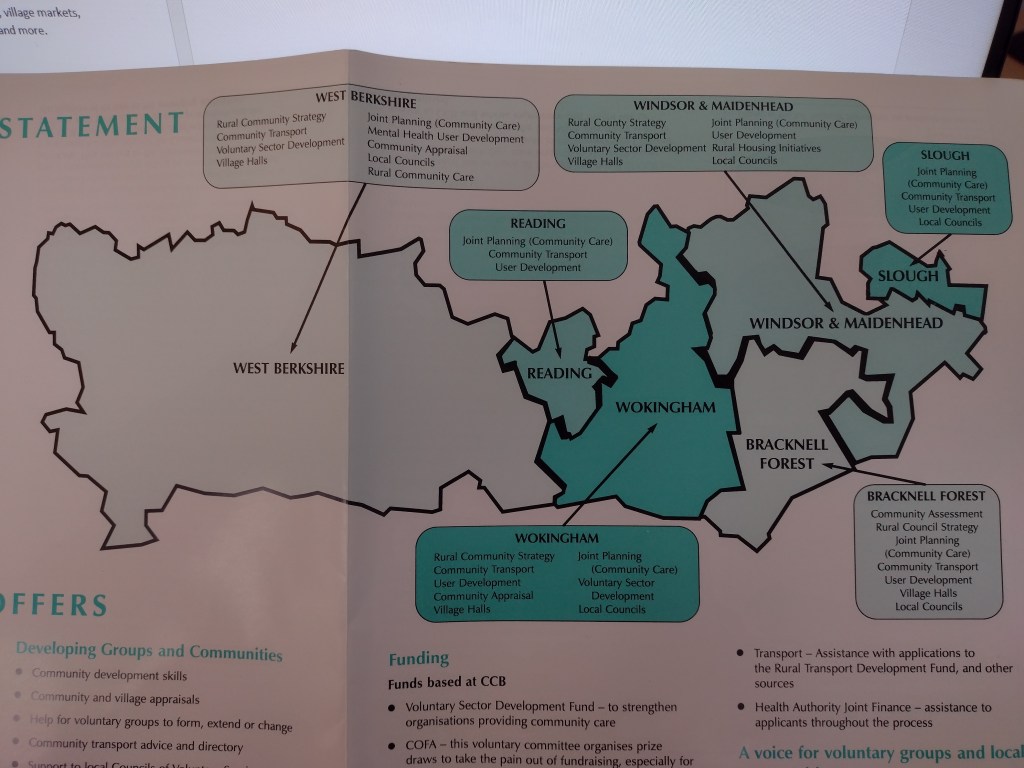
Thank you to Berkshire’s Council for Voluntary Service for the information contained in this article – Volunteer Centre West Berkshire, Slough CVS and Wokingham & Bracknell InVOLve.









 Connecting Communities in Berkshire