Our AGM and 21st Century Community Halls Event at Chieveley Village Hall

Welcome and Opening of the AGM

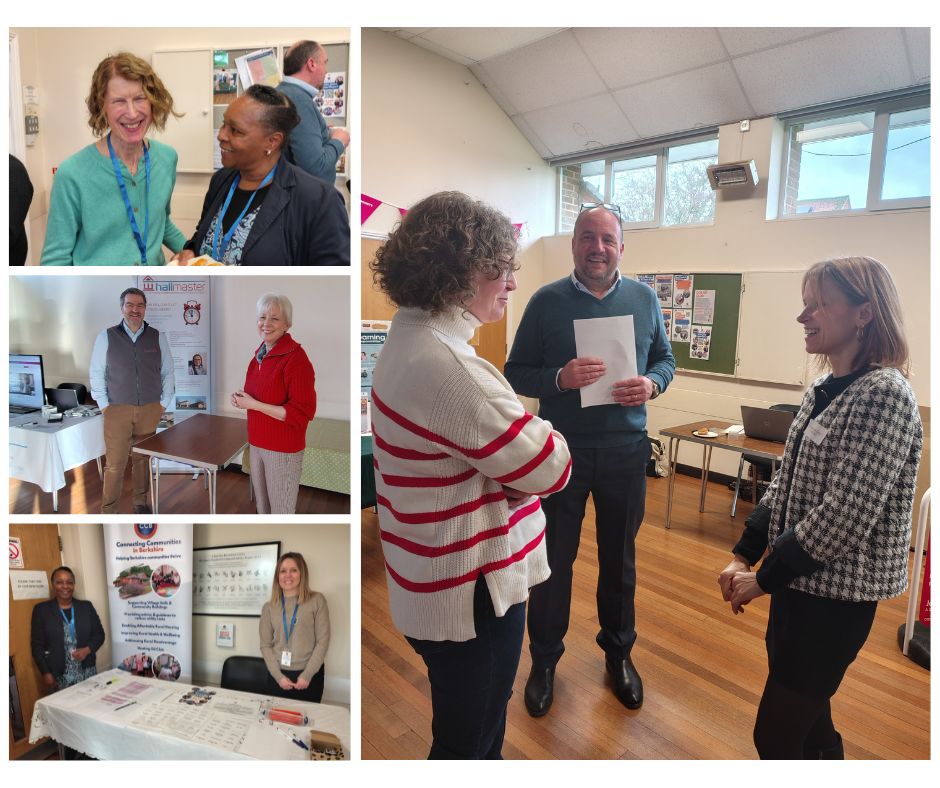
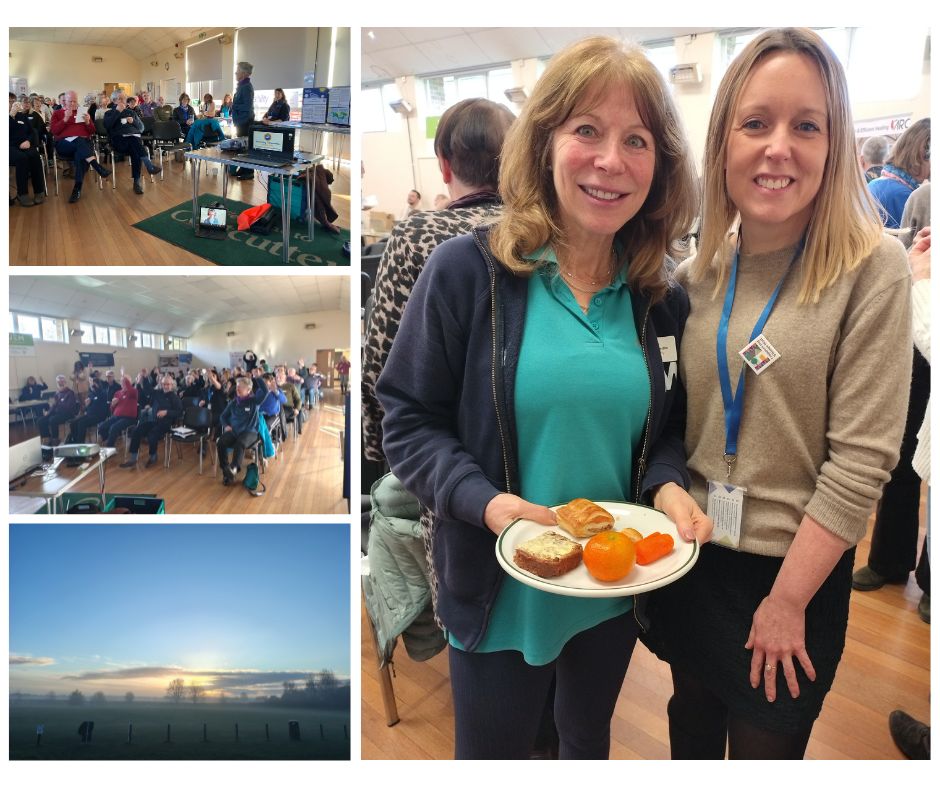
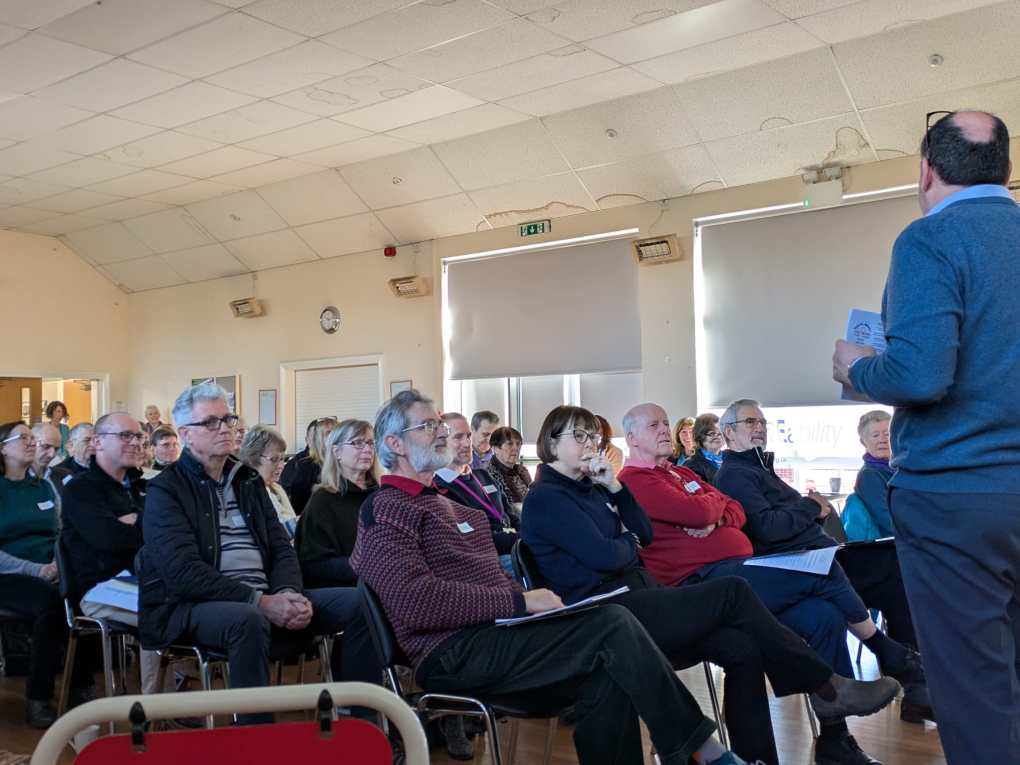
On 28th January 2026, on a bright but bracing winter morning, over 50 guests gathered for our Annual General Meeting and our 21st Century Community Halls case study event at the brilliant community hub that is Chieveley Village Hall. It is a venue we always enjoy visiting and it provided a fantastic backdrop for a day of sharing project updates, catching up with members and friends of CCB, and celebrating the achievements of our 21st Century Community Halls project.

We were joined by a wonderful mix of people. Members came from community buildings and parish councils right across the county, and we were delighted to welcome partners, funders, stakeholders and our Trustees. It felt like a real gathering of the CCB family.

AGM Highlights

Mark Nevitt, our Chair, and Tim Parry, our CEO, opened the morning and guided us through the AGM business. This included officially welcoming three new Trustees to our Board: David Oram, Annie Moon and Alison Taylor. We are very much looking forward to working with them.

We also said goodbye to Sarah Morland, who completed two three-year terms. As Mark reminded us, Sarah had a remarkable rise, joining in March 2020 and becoming Chair within six months. She has contributed an enormous amount to CCB and has been a thoughtful and passionate advocate for Berkshire’s communities. We are incredibly grateful for everything she has done.

With the AGM concluded, Tim gave an overview of our work over the past year, highlighting key projects and achievements.

Rural Housing Enabler Spotlight

Tim then introduced our Rural Housing Enabler, Maria Kelly. Maria talked us through how the Rural Housing Enabling project works, why it requires time and careful consultation, and the kinds of support rural communities can expect. She shared examples of current work in Beenham, Compton and Waltham St Lawrence and explained some of the excellent data tools she uses to map local need and rural housing stock.

Moveability and the Benefits of Seated Exercise

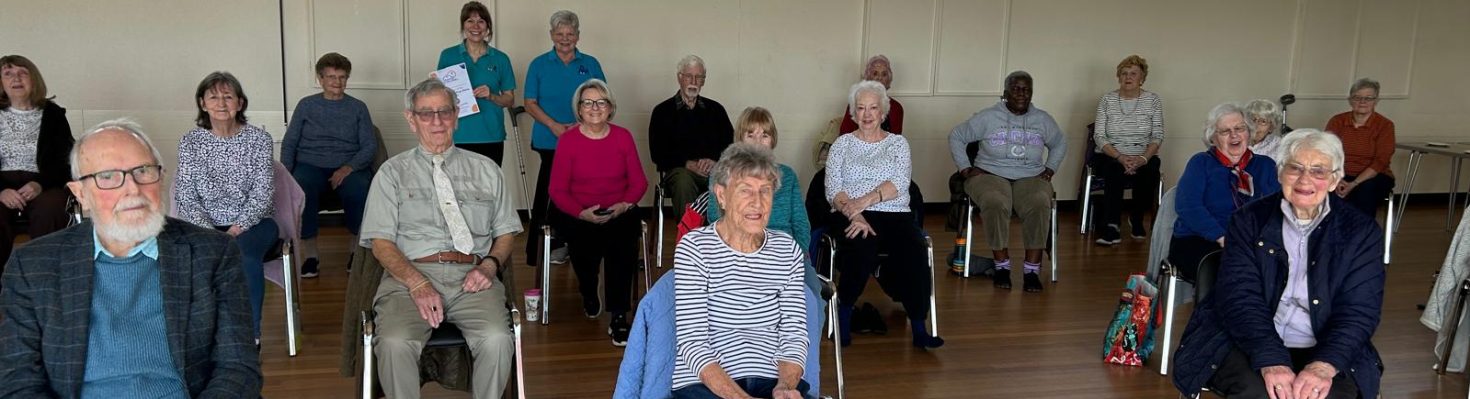
Next, we welcomed Debbie Medlin from Moveability. We have been working with Debbie for several years, helping her secure funding to bring her seated exercise classes to rural communities across West Berkshire, including Chieveley, Hermitage and Lambourn.

Debbie spoke about the benefits of the classes, not only for physical wellbeing but also for reducing isolation and building connections. She finished with an energetic taster session to what must be one of the happiest songs ever recorded, Ob La Di Ob La Da by The Beatles, which certainly lifted the room.

21st Century Community Halls Case Study Training Session

After a break for networking and an excellent brunch, we moved into the 21st Century Community Halls training session led by our Community Building Advisor, Kate Meads. This was a real highlight and included first hand insight from Neal Courtney from Chieveley Village Hall.

Neal talked us through the hall’s development journey and how the Trustees and a dedicated group of volunteers created a development plan, carried out meaningful community engagement and put together a fundraising strategy to support the hall’s long-term ambitions. Hearing their story while sitting in the very building they were describing brought everything to life.

The National Innovation Centre for Rural Enterprise (NICRE) joined us to share how they are supporting CCB to learn from, develop and evaluate the outcomes of the 21st Century Halls Project. Sarah Best presented a new set of Village Hall case studies, featuring Shaw‑cum‑Donnington, Arborfield, Farley Hill and Speen, highlighting the different approaches halls are taking to modernisation and community engagement.

Debbie from Movaebility running a taster seated exercise class

Reflections and Key Takeaways from the Day

Overall, the day left us feeling energised and connected. It was a strong reminder of the value of our work, the commitment of our Trustees and partners, and the creativity of communities and volunteers who find new ways to support local people.

We heard first hand how long-term projects like rural housing need time and collaboration, how small interventions such as seated exercise can spark positive social change, and how village halls can thrive when motivated Trustees, a clear plan and community voices come together. Most importantly, it reinforced why we do what we do: helping Berkshire’s communities thrive by supporting places, projects and relationships that last.

Feedback from Attendees

“The event was just what we needed. It is great to see what others are doing and how CCB is supporting improvement projects.”

“What a great session. We have several community buildings on our patch who would really benefit from membership so they can access support from the 21st Century Community Halls Project. I will be encouraging them to join.”

Final Thoughts from Tim and Kate

Tim said: “I would like to thank all our members and other delegates for supporting CCB at our AGM and conference yesterday. Thank you to Sarah and colleagues from NICRE for sharing their ongoing evaluation of our 21st Century Halls project and to Neal for sharing his team’s inspiring work to improve Chieveley Village Hall. These conferences are a great way of bringing like-minded people together and are a genuine highlight of our year.”

Kate said: “The best part of the day was simply having so many different people in the room together. It was great to have time to chat informally, hear presentations, ask questions and wander around talking to service providers and trustees who have used solar installers, infrared specialists and online booking systems. We also loved hearing from our learning partner, NICRE, about how they are capturing the impact of CCB’s 21st Century Halls Project. It was brilliant for everyone to hear about our other projects too because there is so much crossover. A village might also be linked to our fuel poverty project or our rural housing enabler work, or realise there is a need to run more activities for people who are socially isolated. Having all those conversations in one place made the day feel really exciting.”


What Exactly Are ‘Managing Trustees’?

Committee Members. Trustees. Committee of Management.
They may go by different names, but they all refer to the same role. Regardless of the title, your charity’s governing document will define them as the individuals responsible for running and managing the organisation.


The Essential Trustee: Six Main Duties

Trustees are the people legally responsible for making sure a charity is well-run and delivers on its purposes. The Charity Commission outlines six key duties for Trustees—vital reading for anyone in the role.


Elected, Co-opted, and Representative Trustees

Charities appoint Trustees in different ways, but this must always follow the procedures outlined in the governing document. Common types of appointment include:

  • Elected – Voted in (usually annually) as individuals who are committed to the charity. They may have links to other organisations, but they serve as independent individuals.
  • Co-opted – Some governing documents permit the co-option of Trustees, either to fill a vacancy or to bring in needed expertise. It’s important to follow the rules—does the document allow co-option? What is the process? Do they need to stand for re-election at the next AGM?
  • Representative – Many charities have provisions for appointing a Trustee on behalf of a stakeholder organisation, such as a parish council or a service-user group.

Regardless of how they are appointed, all Trustees:

  • Share equal responsibility and liability
  • Have equal say in decision-making
  • Must act in the charity’s best interests and to further its purposes
  • Should make decisions independently, free from outside influence

This is especially crucial for representative Trustees or those with external affiliations—they are not there to speak for another organisation but to act solely for the good of the charity.


So, What Do Managing Trustees Actually Do?

They carry out the charity’s aims and ensure its purposes are fulfilled. While that sounds simple, it’s easy to stray from the path.

Managing Trustees must:

  • Follow the governing document, which defines the charity’s purpose and what Trustees are authorised to do. If the document is outdated, CCB can provide guidance on updating it.
  • Make and record clear decisions by minuting Trustee meetings and ensuring decisions align with the charity’s objectives.
  • Stay informed about the legal responsibilities of Trusteeship. The Charity Commission’s “The Essential Trustee – What You Need to Know, What You Need to Do” is an important resource. Refresher training is recommended—and CCB offers training and advice.
  • Maintain a quorum—Trustee meetings cannot make decisions unless quorate. Plan ahead to ensure replacements are identified before Trustees step down.

Chairs, Treasurers, and Secretaries

Even if someone holds an officer role like Chair, Treasurer, or Secretary, all Trustees bear collective responsibility. For example, the Treasurer is not solely responsible for financial matters—all Trustees share accountability and should maintain oversight.


Common Issues and FAQs

“I’m on the committee but I’m not a Trustee.”

You might actually be a Trustee without realising it. This is a common misunderstanding. Or, the committee may be allowing non-Trustees to influence decisions—which is incorrect and should be addressed immediately. Trustees can seek expert input (e.g. a surveyor’s report) but must retain decision-making responsibility.

“I volunteer for the charity as well as sit on the committee.”

That’s absolutely fine and very common. Just make sure your roles are clearly defined, and that you’re always aware of when you’re acting as a Trustee versus a volunteer. Your experience as a volunteer can inform your decisions—but shouldn’t bias them.

“I’m paid to clean the building and I’m also a Trustee.”

This is more problematic.

  • Your governing document may prohibit Trustees from receiving payment or financial benefit.
  • Even if not explicitly forbidden, it is not good practice. Permission from the Charity Commission should be sought.
  • The Trustees must consider: is there a compelling reason to appoint a Trustee over an external person with no conflict of interest?
  • If you operate a cleaning business and are offering a service (not direct employment), the Trustees must follow a robust procurement process—assessing quotes, declaring conflicts, and ensuring you and your relatives do not participate in the decision.

In all cases, a clear conflict of interest policy is essential.


Final Thought

Trustees must act collectively and in the charity’s best interest at all times. Decisions are made by majority vote, and once made, must be upheld by all—even if you originally disagreed.


Funding Opportunities in April

Newly Opened: Lloyds Bank Foundation – Local Collaborations Programme

This programme will support collaborations led by small charities seeking to influence and achieve local or regional change around improving the social security system, improving access to suitable accommodation, and support for asylum seekers and refugees. Collaborations can apply for grants of £100,000 over two years.

We would expect your influencing work to align with at least one of these themes:

making the social security system work better for those facing the greatest challenges;
making sure people facing complex issues have access to suitable accommodation;
improving support and services for asylum seekers and refugees.
This funding cannot be used to fund direct delivery of services and is exclusively to support partnerships to influence locally and regionally.

Apply for funding under our local collaborations programme.
Deadline: Complete the Expression of Interest by 30 April 2025

Newly Reopened: One Stop Community Grants

Successful applicants will receive an initial grant of up to £1,000 and begin a partnership with their local One Stop store.

This programme is designed to support community groups or organisations operating within two miles of a One Stop store and which are;

Tackling food poverty
Supporting the vulnerable
Supporting the elderly
Supporting low-income families
Running youth sports teams
Reducing / recycling waste
Improving the environment
Please note we cannot support food bank/breakfast club projects that are requesting funding to purchase food items. However please contact your local One Stop store manager as it may be possible to discuss setting up food bank donation point at your local store. Funding can be awarded to food banks for equipment such as fridges, freezers or to purchase storage units.

The programme provides partnership as well as financial assistance. Alongside a grant of up to £1,000, and the opportunity to create a long-term tailored programme of support for successful applicants with their local One Stop Store Team. Grant recipients then work in partnership with the One Stop Store Team at their local shop to deliver support to the community.

The tailored support from the store teams will help community causes to increase or improve their service by assisting in areas such as, but not limited to, volunteering support, fundraising and awareness-raising.

Please only submit one application, so please prioritise your key project and do not submit applications for more than one project and do not submit multiple applications but with different store postcodes. If you have received funding from One Stop Community Partnerships in the last 12 months you are ineligible to apply for funding on this occasion. If you have received funding for a project more than 12 months ago, you are welcome to apply.

Deadline:

Applications open Applications close Decision Date W/C
3 March 31 March 12 May
2 June 30 June 11 August
1 September 29 September 10 November

Eling Estate

The key objectives for the Trust and Estate include:

The advancement of the Christian religion and the teaching and usage of Orthodox Churches of the East;

The relief of sickness and/or poverty;

The long-term maintenance of the character of the Estate, and the local environment, and:

Management of the woodlands and other features of the Estate for the public benefit and to facilitate public access where appropriate.

The Trustees meet three times a year to consider applications for donations to charities. Applications are generally considered where they meet all of the following criteria:

An applicant must be an established registered charity;

The grant should relate to activities in West Berkshire or neighbouring counties;

We are not able to give to overseas charities or funds;

Grants for projects rather than general running costs are favoured;

Grants should fit into one or more of the following categories:

The advancement of the Christian religion and particularly the Greek and Russian Orthodox Churches;

Community or Education facilities and provision of support;

Social and Welfare support and therapy.

Applications should be made in writing, including a copy of the most recent charity accounts. Send to:

Shoosmiths Foundation

About Us: The Shoosmiths Foundation is a grant-making body working to help address societal issues, to empower sustainable change and to improve the lives of the people and the environment in the UK.
Criteria: Offering UK-based registered charities grants for projects that advance access to justice in Shoosmiths locations across the UK. Proposed projects should achieve one of the following:
Sustaining or improving community access to specialist legal advice.
Leveraging organisation’s and educational institution’s pro bono programmes to increase access to justice.
Projects must address underrepresentation and support intersectionality more broadly. For example, projects that not only support access to justice prospects but also address other factors of underrepresentation such as:

Characteristics listed in the Equality Act 2010.
Ex-military personnel.
People with convictions.
People experiencing homelessness.
Long-term unemployed.
Refugees.
Care-experienced individuals
Grant Size: Between £25,000 and £50,000
Deadline for applications: 4pm on 18th April

Matthew Good Foundation

About Us: Grants for Good is funded by the John Good Group and is designed to direct funding only to small and growing local charities, voluntary groups or social enterprises that are making a big impact on communities, people or the environment.
Criteria: To be eligible, applicants must:
Be a local community group, charity, voluntary group or social enterprise that has a positive impact on communities, people or the environment.
Have an average income of less than £50,000 in the last 12 months.
Have a bank account in the organisation’s name
Grant Size: Up to £5,000
Deadline for applications: Ongoing

CLA Charitable Trust

About Us: We support charitable organisations that access the benefits of the countryside to pursue the health and wellbeing of people and to provide opportunities for education about the countryside in England and Wales.
Criteria: The CLA Charitable Trust awards grants to small and medium sized charities and not for profit organisations such as CICs that access the benefits of the countryside to pursue the health and wellbeing of people and to provide opportunities for education about the countryside in England and Wales. The Trust prioritises organisations working with children and young people and those disadvantaged financially, physically, mentally, or from areas of deprivation.
Examples of eligible activities engaging young people and communities in these areas include, but are not limited to:

Farms providing day or residential experiences for disabled or disadvantaged young people.
Growing projects including horticultural therapy and community projects supporting people through outdoor activities and gardening.
Forest school type activities giving people the opportunity to utilise their outdoor spaces for the benefit of their mental and physical wellbeing.
Conservation and environmental projects giving people the chance to learn about the natural environment and how to care for it.
Grant Size: Up to: £5,000
Deadline for applications: Ongoing

Libraries Improvement Fund – Arts Council England

This fund will enable library services across England to invest in a range of projects to upgrade buildings and technology so they are better placed to respond to the changing ways people are using them.

Local authorities can apply for capital expenditure between £50,000 to £500,000.

Expressions of interest will open on 6 May and close on 30 May 2025.

The Big Bike Revival – Cycling UK

The Big Bike Revival is an intervention for adults aimed at encouraging an uptake in cycling. By providing solutions to perceived barriers, adults are enabled to learn to how to cycle and to increase their cycling levels for short, everyday journeys. Events focus on presenting cycling as a practical, normal and habitual way to get around locally.

The Big Bike Revival is delivered across England by a wide range of community-embedded partners. Typically, these are volunteer-led groups, not-for-profit organisations and social enterprises that are rooted in local communities and working to address a range of local needs. Such groups can apply for grants to run events as part of Big Bike Revival.

Grant funding is available for any amount up to £3,500.

For Grants of £2,000, partners should be able to deliver at least 6 events.
For Grants of £3,500, partners should be able to deliver at least 10 events.
Events must take place between 18 April and 31 October 2025. The deadline for applications is 14 July.

Physical Activity Grants Programme – Parkinson’s UK

This programme supports activity providers, communities, networks, organisations and others to develop opportunities for people with Parkinson’s to become and stay active.

Projects must run for a minimum of 12 weeks and a maximum of 52 weeks and must start within 12 weeks of receiving the grant.

Applications can be made for a minimum of £500 up to a maximum of £3,000. Up to 100% of costs are available if required,

Applications opened on 10 March and will remain open until all funds are allocated.

Football Foundation grants

Football Foundation grants are available to football clubs, schools, councils and local sports associations under the following categories:

Goalposts
Storage containers
Portable floodlights
Changing pavilions and clubhouses
3G pitch maintenance machinery and equipment
Fencing
3G pitches
Creation of new grass pitches
Small-sided facility improvements
Grass pitch improvement
Grass pitch drainage
Grass pitch maintenance machinery and equipment
Premier League defibrillator fund
Premier League stadium fund
Looking for funding | Football Foundation

Skipton Building Society Charitable Foundation

The Charitable Foundation has identified two focus areas through which it aims to drive social impact.

Helping people experiencing hardship and/or underserved groups to:

access a place to call home.
and improve financial wellbeing.
The trustees will select charities based on their alignment with one or both focus areas. The Foundation has committed to fund UK registered charities, where successful, up to a maximum of £10,000.

The current application round will close on 1 May 2025.

Community Tree Planting Fund – Network Rail

The Tree Council and Network Rail work in partnership to deliver a programme of community tree planting. Together, they have already planted more than 300,000 trees in 108 communities across the UK.

Funding for projects is awarded in three bands:

Main Grants – Projects between £2,500 and £5,000
Large Grants – Projects between £5,000 and £10,000
Flagship Grants – Projects over £10,000 and up to £15,000
Flagship Grants will be awarded in limited numbers to those projects that deliver a significant impact across our programme priorities.

Funding is now open and all details are on the website.

Network Rail Community Tree Planting Fund – The Tree Council

Healthy Heart Grants – Heart Research UK
Healthy Heart Grants of up to £15,000 are available for community projects aimed at supporting adults to reduce their risk of coronary heart disease, helping them to live healthier, happier and longer lives. The grants are available to charities and community interest companies across the UK.

The application windows for 2025 in England are:

England North: 7 May to 4 June
England South: 16 July to 13 August
Healthy Heart Grants – Heart Research UK

Youth Music Trailblazer Fund

The Youth Music Trailblazer fund offers grants of £2,000 to £30,000 to organisations in England to run projects for children and young people (25 or under) to make, learn and earn in music. The project should trial work or test a new way of working, sustain a grassroots programme or disrupt the status quo (or all three!).

Your work must meet one of the Fund’s themes:

Early years
Disabled, d/Deaf and neurodivergent young people
Youth justice system
Young people facing barriers
Young adults
Organisations and the workforce.
The deadline for applications is 11 April 2025.

Community support small grants – Trusthouse Charitable Foundation

Single year grants between £2,000 and £10,000 are available to charities and not for profit organisations for core costs, salaries, running and project costs. Projects must have a focus on Community Support and address urban and rural deprivation in the UK.

if you are located in a rural area, you must be in the bottom 50% most deprived areas according to the Index of Multiple Deprivation. Your annual income must not exceed £250,000 and you can secure 50% of the total project costs.

This is a rolling programme with no deadlines.

Neighbourhood Planning Grant Funding – Locality

Government has confirmed the continued importance attached to supporting neighbourhood planning and on 1 October 2024 launched the procurement process for the new contract for Neighbourhood Planning Support Services for 2025 to 2027. Government intend to sign the new contract in April 2025 for the new services to open from July 2025.

To read more on funding opportunities, click the Rural Services Network April 2025 Funding Digest.

Home Instead Charities

Money raised from our dedicated network of Home Instead Offices and external supporters fund groups who support the mental, physical, and emotional wellbeing of ageing adults.

If you are a small grass roots organisation you can apply for funding up to £500. If you are a small local registered charity you can apply for funding up to £1,500. If your group is a registered charity, you must attach a copy of your governing document AND your last set of accounts. If either of these documents are missing, we will not be able to process your application.

Most of your group members must be over 55 years old or the project you are requesting funding for must benefit people aged over 55. The project must support its members through activities and projects that support wellbeing or reduce social isolation and/or loneliness. Your group must be open and inclusive irrespective of race, religion, disability, sex or sexual orientation.

We will only fund individuals if it is to provide access to your group, i.e. transport costs or communications devices to access your groups activities. We will only fully fund grant requests from organisations who hold no more than 3 months operating costs in reserve. If you have more than this, the charity will only co-fund your project up to a maximum 50% of the funding required.

We will consider applications from groups, associations and charities that do not service the over 50s directly but the project they require funding for does, i.e., a local school wishes to hold a special afternoon tea for its local care home residents.

If you are a registered charity your application must be accompanied by a copy of your constitution and annual accounts.

The National Lottery – Reaching Communities

About Us: With this funding we’ll help strengthen communities and improve lives across England. Our funding is available to all communities. But our priority is the places, people and communities that need it most.
Criteria: Voluntary or community organisations in England. Our priorities are to fund projects that:
support places, people or communities experiencing poverty, disadvantage or discrimination
and
support people and communities to shape the decisions that affect their lives.
And your project must achieve one of our missions. Which are to support communities to:

Come together, through inclusive places, spaces and activities (either physical or virtual). Especially for communities where people are least able to come together.
Help children and young people thrive, by developing positive social and emotional skills.
Be healthier, by addressing health inequalities. And helping prevent poor health.
Be environmentally sustainable. By engaging with climate issues and having a positive environmental impact. And improving access to quality natural spaces.
Grant Size: £20,001 to £500,000
Deadline for applications: Rolling

Thank you to RSN Online, Volunteer Centre West Berkshire, Slough CVS and Wokingham & Bracknell InVOLve for the information contained in this article.
Village HallsWeek is back for its ninth year!

From Monday, 17th March, we’re celebrating, encouraging, and supporting the amazing volunteers who keep village halls open and thriving across England.

This annual campaign, led by Action with Communities in Rural England, highlights the vital role of the country’s 10,000+ village halls in bringing communities together.

Share your photos, stories, and messages that showcase what makes your hall and its volunteers so special! Use #VillageHallsWeek and tag us – we’d love to celebrate your contributions and share them with our community. Got exciting plans for Village Halls Week? Tell us about them and we’ll help spread the word!

Let’s make this year’s #VillageHallsWeek the best one yet! 🎉

For halls in Berkshire, we have three exciting events happening next week;

TRUSTEE TRAINING

Join this online event to refresh your skills or if you are a new trustee and invite people who you would like to consider becoming a trustee so they can find out what trustees do!

Location: This is an Online event. Tuesday 18th March 2025, 7 pm – 8.30 pm. Book here

WEBSITE BUILDING

Website Building: Hugo Fox offer FREE website building for Charities. Their professionals will help you begin to build your own website. Please bring your laptop, photographs of your facilities, and some words/information about the hall so you can begin building your own webpages.

Location: The Victory Hall, Church Rd, Farley Hill, Reading RG7 1TR. Thursday 20th March 2025,10 am – 12 noon. Book here

CELEBRATORY LUNCH & NETWORKING EVENT

Location: The Victory Hall, Church Rd, Farley Hill, Reading RG7 1TR. Thursday 20th March 2025 arrive from 11.30am. Lunch & networking 12 noon – 1.30pm. Book here

Please join us for an informal networking event and delicious lunch. We want to celebrate all the people who help run our village halls and community buildings. This event is a simple Celebration of their Hard Work and Volunteering. Lunch is provided by a wonderful local tea room and will consist of a traditional afternoon tea of sandwiches, cakes and scones, washed down with plenty of tea and coffee! If you’d like to attend and haven’t already let us know please email admin@ccberks.org.uk


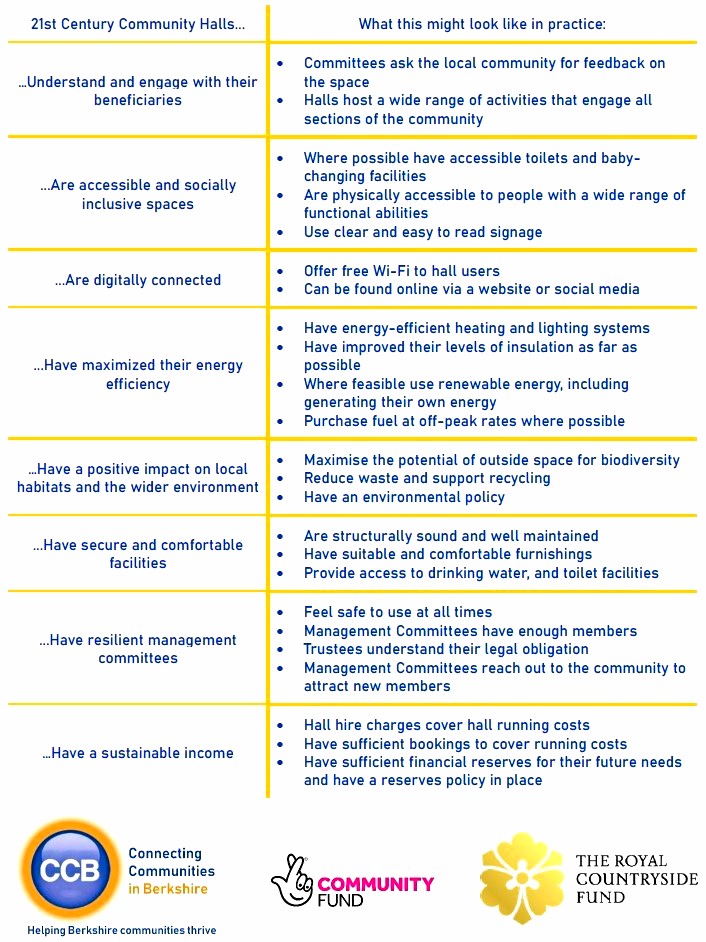
21st Century Community Halls: End of Year 2 of this five year project

The 21st Century Community Halls project has made significant progress, conducting initial consultations with halls and increasingly focusing on follow-up reviews. With the recent addition of a new Project Development Officer, David, the project has gained momentum and has introduced initiatives to address common themes shared by many halls.

The Initial Consultation: We have completed 13 further 21st Century Community Hall initial reviews during this period. Each review is completed during a visit to the facility with additional information provided before and after. The review includes over 120 questions divided into 7 parts:

  • The Building and the Organisation
  • Sustainability
  • Environment
  • The Fabric of the Building
  • Energy
  • Accessibility
  • After the consultation a comprehensive report is prepared for the Hall’s management team
    with a pack of suitable supporting information. After considering the contents, comments, and actions, we ask Trustees to draw up an action plan for the key issues they want to address. CCB then assist with advice for the resulting actions and projects that these form into.

The Follow-Up Reviews: CCB seeks a follow-up with the management committee approximately every 6 months via a call, or a visit depending on the needs of the
committee and on the activity and challenges. To date we have completed 22 formal follow-up reviews of halls we have consulted with.

Learning Partner Selection: We have now selected a Learning Partner to help us evaluate the project, and will begin working with them in January 2025.


One-to-One Support: During this period, in-depth one-to-one support has been given to halls for their development actions:

  • Providing best practices and examples for Business Planning to 15 Trustees from 14 different Village Halls in Berkshire.
  • Writing, reviewing and successfully obtaining funding from The Platinum Jubilee Fund.
  • Developing Fundraising plans with three separate committees and delivering Fundraising training around ‘evidencing need’ to 8 trustees from 6 different Village
    Halls.
  • Designing, conducting and analysing Community Consultations with three separate committees.
  • Risk review and support with one new member.
  • Supporting a member hall in updating its governing document.
  • Supporting a Village Hall to review plans for a complete rebuild in favour of a major refurbishment (due to financial restrictions and community feedback)
  • Renegotiation of a lease for one Community Hall.

    If you would like your hall to participate in the 21st Century Village Halls project, please email me. kate.meads@ccberks.org.uk and we can arrange a time for a consultation.