Without affordable housing, rural communities are at risk of becoming lifeless, dormitory settlements

by Phillip Vincent, ACRE’s (Action with Communities in Rural England) Communications Manager, blogs for Rural Housing Week 2021 and provides a view on the need for the government to get behind communities and deliver affordable homes in the countryside.

Recently, there has been growing alarm about Covid-related urban flight to the countryside, where housing stock is hoovered up by home workers or purchased as holiday lets or second homes.

Rightly, critics point to consequences such as the upward pressure on house prices, the inability of local residents to compete with this, the loss of younger generations, and the possibility of some villages in more attractive areas becoming empty during the week which in turn impacts on the viability of local shops and services.

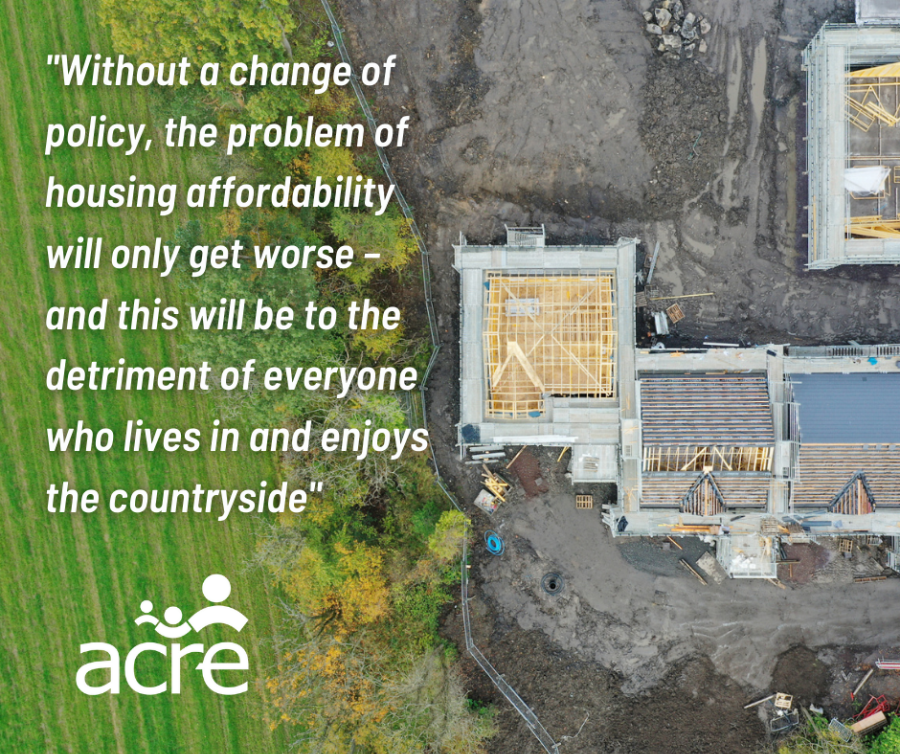
It is too simplistic however, to put the blame on wealthier individuals desiring a better life in the sticks or to say the solution is to put an end to second homes or limit the available housing stock to people who have a connection to the local area. The issue runs much deeper and one which is about to be magnified as part of the government’s proposal to up-end the planning system.

The truth is, there has been a longstanding under-supply of new homes in the countryside, particularly those that are affordable to local residents. Successive governments have failed to address this, either through planning reforms or subsidy. In 2019, just 5,558 new affordable homes were built in villages with a population less than 3,000, whilst 80% of completions were private sector dwellings.

It is unsurprising then that the situation appears to be coming to a head at a time when people are spending more time at home and cannot travel overseas. England’s rural areas have many attractions for those seeking more space. To read the rest of this article from Phillip please click here.


ONLINE WORKSHOP A Walk from Every Hall: Walking for Health in West Berkshire

On Tuesday 20th July at 10.30am, we are facilitating a free, online workshop, to be delivered by Paul Graham, West Berkshire Walking for Health Coordinator. Booking is essential. To book please click here: https://www.eventbrite.co.uk/e/161622319709

Join in with this event to learn about Health Walks, how you can set one up in your local area and the support available from your local Walking for Health coordinator.

Walking for Health walks have been happening in West Berkshire since the early 2000’s, with hundreds of local residents enjoying the benefits of regular physical activity and building friendships and community in their local area.

The COVID-19 pandemic has brought challenges for many people as well as showing us the powerful impact of communities coming together to support each other in testing times. Setting up a health walk can be a simple but effective way to improve the physical and mental wellbeing of your local community now and in the future.

The session will cover:

  • An introduction to the role of Walking for Health coordinator in West Berkshire
  • What Walking for Health is, and what Health Walks are
  • What makes a good walk leader and how to become one
  • The process of setting up a new walk
  • Ongoing support available to walk leaders
  • Case study: Mortimer Walking for Health group.
  • Why you should consider setting up a health walk in your community

Get Berkshire Active: Ever Active Programme

Ever Active sessions More sessions now GBA Ever Active programme expands the list of its sessions, both virtual and face-to-face. FREE virtual online classes: Mondays at 10am Chair Yoga with Sami – https://www.eventbrite.com/e/136449158105

Mondays at 11am Gentle Chair exercise with Debbie and Mandy from Mindset Massage – https://us02web.zoom.us/meeting/register/tZctd-uppjwvHdD0UHLA0KM1bGFWFz-cUcYh

Wednesdays at 11am Gentle Chair exercise with Kate – https://www.eventbrite.com/e/136450191195

Thursdays at 11am Gentle Chair exercise with Kate (This class will discontinue in July). Date TBC. https://www.eventbrite.com/e/137594156827

Fridays at 11.15am Gentle Chair exercise with Hayley – https://www.eventbrite.com/e/136450532215 If you know anyone who needs help accessing or booking the above online classes please contact our Ever Active Ageing Officer Kate KATE.WIGGINS@GETBERKSHIREACTIVE.ORG

Face to Face Ever Active Community Classes – West Berkshire: Every Friday St Catherine Church Hall, Wittenham Ave Tilehurst RG31 5LN, Friday 11.30am – 12nnon Gentle Chair Exercise with Juliet.

Starting Monday 28th June 2021 Royal British Legion, 20 Church Way Hungerford RG17 0JU, Monday 11.30am – 12noon Gentle Chair Exercise with Hayley. Indoors.
Face to Face Ever Active Community Classes – Reading: Starting Thursday 24th June Southcote Community Hub, Coronation Square RG30 3BA, Thursday 2.00pm – 2.30pm Gentle Chair Exercise with Kate. This class is outside on the green area. Booking is essential for the above classes due to limited spaces so please email Kate kate.wiggins@getberkshireactive.org to secure your place and to request a Registration Form.   

Research reveals impact of the pandemic on village halls

Whilst 3 in 20 halls supported Covid relief efforts, the majority stayed closed and will need ongoing support and funding to recover.

Much has changed since England’s 10,000+ village halls were surveyed at the beginning of 2020 by our national body, Action with Communities in Rural England (ACRE).

Almost immediately after the survey closed, so too had the majority of these buildings – and with it the community activities, events and rural livelihoods they ordinarily provide a space for.

Now, new research sheds light on the extent to which halls have been variously affected by three successive national lockdowns.

15% of halls contacted said they had played an active role in supporting their community during the pandemic. Taking advantage of exemptions in the regulations, they provided a limited number of ‘essential services’ to support vulnerable members of their community and help the NHS – sometimes without any additional resources.

Through its network, ACRE is aware of a number of halls, such as Wraysbury Village Hall in Berkshire and Yarm Community Centre in Durham, that have stepped up to the plate and used existing facilities to prepare meals on wheels and delivery services providing a lifeline to isolated members of the community.

Others, like Frenchay Village Hall in Gloucestershire continued to provide childcare for key workers and in Mawdesley Village Hall in Lancashire, the committee went one step further and transformed their main hall and annex to help their local primary school accommodate more children safely for the last three weeks of term last year.

Creative solutions were also found in the face of crisis. For example, in Warwickshire, the volunteer committee managing Shotteswell Village Hall set up a scrubs’ hub making protective clothing for NHS workers.

And more recently, some village halls like Clifton Hampden Village Hall in Oxfordshire have been used as vaccination centres serving the wider rural area.

But aside from these inspiring examples of community camaraderie, many halls expressed concern that they would find it hard to attract volunteers and users back once they reopen, particularly older generations who may be less inclined to meet in person.

Dr Tom Archer, of Sheffield Hallam University who authored the report said, “Halls face major challenges in reopening and re-establishing services. The pandemic has had a significant impact on their volunteers and staff, as well as their users, and the future remains very much uncertain.

What we’ve learnt is that the last year has affected halls in diverse ways. Whilst a third of respondents to the survey said their financial situation had improved during the past year, a similar proportion said their situation had worsened, with many drawing on their reserves. Most worryingly, we have reason to believe at least 140 halls nationally could close and not reopen without further support.”

Deborah Clarke, ACRE’s Rural Evidence & Village Halls Manager said, “The research demonstrates a clear and urgent need for continued funding support to be made available to village halls during this period of uncertainty, particularly those facing financial difficulty. This should involve bridging funds and continued relief from business rates.”

If you are a hall or community buildings based in Berkshire please visit our Community Buildings Advice page for further information on how CCb can help you.

Findings are based on a follow up questions to the 2020 Village Halls Survey, answered by 1,017 halls from across England between March and April 2021. The research was undertaken by The Centre for Regional Economic and Social Research, Sheffield Hallam University on behalf of ACRE and funded by the Department for Environment and Rural Affairs.

West Berkshire Volunteer Recruitment & Retention Training

FREE Online Session

Tuesday 6 July 10am to 12 noon

Finding the right people, with the right skills, and then keeping them can be a challenge for organisations reliant on volunteer support.

This course will explore attitudes towards volunteering, how to recruit and retain volunteers and how to manage them effectively. There will be opportunities for you to share experiences and ask questions.

The aims of the course
• To challenge attitudes towards volunteering.
• Demonstrate proven recruitment and retention ideas.
• Stimulate thinking that could be used in your own community settings.

What will I get out of it?

Course outcomes:
• Gain a wider knowledge of the principles behind successful volunteer recruitment.
• Be inspired to think about different ways to recruit people.
• Encourage wider thinking around volunteering and how your work adds value to society.
• Inspire a volunteer recruitment campaign for your organisation.
• Think about existing volunteers and how to reinvigorate their stake and to ensure they are engaged and in tune with your aims.
• Participate in a collaborative way and to share your own experiences.

Who’s delivering the course?

Garry Poulson, Director, Volunteer Centre West Berkshire
Garry has extensive knowledge of recruiting and retaining volunteers. He has been running the Volunteer Centre for 23 years, playing a leading role in local and regional voluntary and community initiatives. Garry has designed and implemented a range of volunteer lead projects and programmes that work in close partnership with local authorities and communities. He manages around 220 volunteers and three community transport schemes.

Chris Read, Volunteer Recruitment Officer, Volunteer Centre West Berkshire
Chris has worked in the not-for-profit sector for 18 years and has been responsible for managing volunteer recruitment at the Volunteer Centre for the past 6 years. By meeting potential volunteers and using IT software that matches volunteers to suitable voluntary roles, Chris will outline how he can support you with your volunteer recruitment.

Book your place

To book your place email jan@vcwb.org.uk
A Zoom link will be sent to you after booking.