At Connecting Communities in Berkshire the summer was spent delivering our community focusing training delivery through Zoom webinars. We successfully delivered a number of training webinars to volunteers and community groups in Berkshire on subjects like accessing funding opportunities, community led housing as well as specialized training for Trustees of Village Halls. We thank the Adult Community Learning Teams in West Berkshire and Wokingham Council for their funding support.
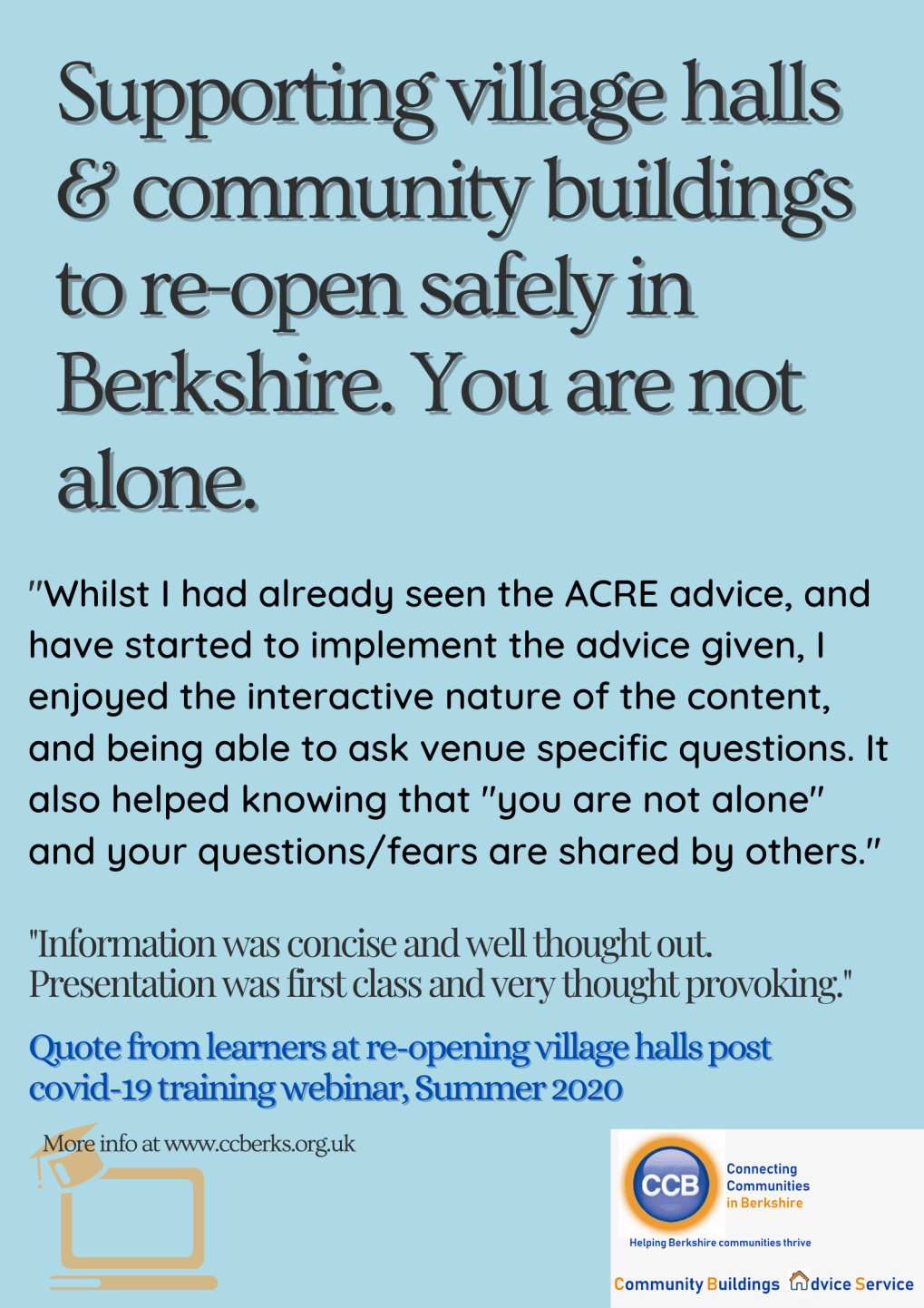
Village Halls and Community Buildings play a major part in community life in Berkshire and pre Covid provided a fantastic meeting point for fitness & dance classes, indoor markets, afternoon teas, weight management programs, brownies/cubs meetings, lunch clubs, birthday parties, toddler groups, theatre performances and many more ‘coming together’ opportunities. The role that village halls play in helping local people to combat loneliness and isolation should not be undervalued and like many other groups and businesses have suffered from a lack of income during lockdown and a new set of seemingly confusing and ever-changing rules in re-opening. CCB’s Community Buildings Advisor Kate Meads, with help from our national network Action with Communities in Rural England (ACRE), pulled together a course specifically designed to help and re-assure trustees regarding how they can re-open safely and measures they need to arrange to ensure that can happen safely. The course was very well attended and received with some fantastic comments from learners.
“Very informative especially on how to risk assess and when to safely open the hall. Advice about checking the objectives of the Charity so that specific activities may re-start rather than just keeping the hall permanently closed. Have had confirmation that the hall will receive a grant and this will help hugely to cover loss of income and to pay for necessary PPE and extra cleaning.”
“Faced with a daunting amount of paperwork, I was very worried about what we needed to do about reopening our Hall. Kate’s presentation was very reassuring and gave me confidence to get on with the job!”
We don’t know yet what kind of winter Berkshire will be in for in 2020-21 yet but the colder months can cause a range of issues for heating oil users and we wanted to share with you some top tips that will help you feel more confident this winter.
Do you need a top up? With winter being the prime time for heating suppliers, ordering your oil before that rush can save you some pennies. If you will need a top up soon buying your heating oil before the lower temperatures creep in could save you money. Marion at OFPS who manages the CCB Oil Club always recommends buying your oil early in the winter if you can and not to wait until the temperature drops before checking if the tank needs topping up as traditionally prices always rise when demand is greatest. Over the summer months CCB Oil Club members saved over £650 on orders compared to normal prices. Our club is open to anyone on heating oil to join from within Berkshire, saving you money, reducing oil tank deliveries and helping to support a local charity please click here for more details on the club.
Check your heating oil tank for damages Don’t forget to give your tank a once over as with changeable temperatures in the autumn and winter seasons, any damages that your oil tank may have can worsen due to the weather. Look out for cracks, rusting, tank bulging, distortion, loose/damaged caps and filling points and if you do notice any issues try to get them fixed before leaks and other expensive problems can occur.
Get a boiler service Your boiler is vital to keep your home warm in the winter, with boiler working less in the summer preparing it for the extra work in the winter reduces the risk of a breakdown. It is recommended that those who have a oil- fired boilers should servuce it twice a year.
Tidy Up Cut and neaten any plants around your oil tank. Trimming back the plants around your oil tank now will make it easier in the winter to access your oil tank in harsher weather conditions. Foliage and leaves can get into vents and the bund which can cause a blockage. Keep an eye on your plants as if they are overgrown it can make it harder for you to spot any damage on your tank.
Soften your oil tank lock
Making sure your lock is easy for you to access is important as old locks in the winter weather have a tendency to seize making it harder for you to access and lock up your oil. To reduce accidentally leaving your lock open, aim to lubricate you lock before the cold weather approaches.
by Paul Dixon, Rural Evidence Manager, Action with Communities in Rural England (ACRE)
A coalition of thirteen leading rural organisations is urging the Government to commit to more equitable funding in rural areas to support England’s economic recovery from COVID-19.
The Rural Coalition has published Rebuilding Rural: Growing Back Better, setting out its priorities for a successful recovery by seizing the potential social and economic opportunities across rural England.
Rural areas are home to 9.3 million people – more than Greater London – but they have long faced the challenges of sparsity, remoteness, poor connectivity and a history of unequal funding and patchy service delivery. Some communities which are heavily dependent on tourism and seasonal work are now at risk of being left further behind. The COVID-19 crisis has exposed weaknesses in the narrow economic base of some of these areas, but also highlighted the opportunities rural economies can make to the recovery. Now, this potential needs to be unlocked through a programme of investment.
Phillip Vincent, Action with Communities in Rural England’s (ACRE), Communications & PR Manager reflects on Communities Week 2020 (w/c 21st Sept) and asks what can be learnt from the ACRE Network’s experience of supporting rural projects in these uncertain times. CCB is the Berkshire member of the ACRE Network.
Communities week is a celebration of the contribution that community projects make to people’s lives and the places in which they live. The chorus of praise and stories of inspiring initiatives is likely to be more pronounced than ever this year as across the country many people have volunteered – sometimes for the first time – to help others in their community in response to Covid-19.
In many ways the rural community response to the pandemic has stood in sharp contrast to top-down, state intervention. In rural areas, members of the ACRE Network saw hundreds of mutual aid groups spring up overnight, whilst the ranks of existing good neighbour schemes swelled. And the volunteers that run England’s 10,000+ village halls too have shown great resilience in the face of adversity having been forced to close their doors, apply for emergency funding and then reopen safely. You can read about some of these stories here.
The net impact of this community activity is hard to quantify but there is no doubt in our minds that without it, many vulnerable people would have gone without support, rural communities would have been a lot lonelier and primary care services would have been under even more pressure.
But what can be learnt from the whole affair?
The community response to Covid19 is reassuring but not surprising. Historically, rural communities have looked after their own interests in the absence of state-run services and support. But the significant increase in community initiatives and the diversity of people who volunteered during the pandemic – particularly younger people – goes to show there is a greater sense of shared belonging and enthusiasm that can be tapped into.
The means by which rural communities have organised has changed. Traditionally, many resident-led initiatives have relied on face to face gatherings, often in the village hall. But in lockdown, almost all activity was arranged online through applications such as Zoom, WhatsApp and Facebook. There has never been a time when reliable, fast rural broadband has been more needed.
Whilst communities have clearly proved that they are capable of self-organising during the crisis, sustaining such groups requires longer term support. Cementing the work of mutual aid groups into structured good neighbour schemes for example is indeed possible but we also know this requires organisation, governance, and funding.
The burden of responsibility on volunteers managing community assets such as village halls has been particularly acute. Many committees were extremely worried their charities would not survive lockdown without income from hiring out their hall. Without the support of the ACRE Network, many would not have accessed emergency Covid funding. Nor would they have been able to negotiate the extremely complex and frequently changing government rules on social distancing had ACRE not produced comprehensive information for village halls.
Sometimes it can be difficult for groups to know where to access support. That’s why ACRE has teamed up with the My Community online platform which provides a directory of support and resources available from leading community and voluntary sector organisations. We’re especially pleased the site includes information about how groups can respond at times of crisis.
Lastly, a fresh look at rural civil society is needed. In many ways the rural community response to the pandemic has stood in sharp contrast to top-down, state intervention. Where the government lacked the agility in its response, communities working together through civil society organisations, were better able to see the links between local needs and resources, and therefore better placed to find joined-up ways of addressing them in the most efficient and effective way.
The pandemic has clearly shown the value of community led action. This approach must be encouraged, resourced and built upon in the long run.
With thanks to the Berkshire CVS’s for the information contained in this article – Reading Voluntary Action, Wokingham & Bracknell Involve, Slough CVS and West Berkshire Volunteer Centre.
Food for Life Get Togethers – Small Grants Small grants are available to not-for-profit organisations in specified areas of the UK for community events and gatherings that enable people of different generations to get together through good food. Click here for further information: https://www.foodforlife.org.uk/get-togethers/get-involved/small-grants
BAME Healthy Communities Surviving COVID-19 Fund Grants are available for Black, Asian and Minority Ethnic (BAME) led voluntary, community and social enterprise (VCSE) sector organisations across the UK to help them support their communities during and beyond the coronavirus/COVID-19 crisis, building wellbeing, resilience, and capacity. Click here for further information: https://www.ahpn.org.uk/grants
Berkshire Community Foundation Vital for Berkshire Coronavirus Fund – open for applications until 30 October The Vital for Berkshire Coronavirus fund is now open for applications until 5pm on Friday 30 October Funds allocated to Berkshire through the National Emergencies Trust Appeal for Coronavirus, together with the support they have received for their Vital for Berkshire – Coronavirus Appeal, are available for grants to be allocated to local charities, community and voluntary groups working to help people affected by the crisis in Berkshire.
Fund aims To help organisations respond to immediate needs, for instance, as a result of restrictions to normal activity, supporting those suffering hardship as a result of the short and long-term economic and social consequences. To help organisations with stabilisation i.e. short term core cost funds to keep organisations supporting those in need afloat. To help organisations adapt to the crisis i.e. developing and enhancing services, buying equipment, capacity building or organisational development. Priorities Priority will be given to organisations providing support to the most vulnerable and isolated, including:
Older people People with physical or learning disabilities People with mental health needs People on low incomes Families with young children Who can apply? Charities, community groups or other not for profit organisations who are affected by the Coronavirus pandemic. Charities, community groups or other not for profit organisations who are supporting people affected by the Coronavirus pandemic. Small and new groups which are not constituted may apply where they are working with the local CVS, Parish Council or Local Authority – a letter of support or other evidence will need to be provided. Please also see this information on who can apply.
Berkshire Better Health Fund 2020 – grants of £1,000 to £5,000 available Sport England are providing Get Berkshire Active (GBA) with funding through the Tackling Inequalities Fund (TIF) to distribute to community organisations who support the following priority groups to be active:
people with disabilities people with long-term conditions BAME communities lower socio-economic groups. GBA want to utilise some of this funding to support health-specific projects and use the momentum of the national Better Health campaign to do this. They are keen to connect with any health provider who may include physical activity as part of their service or who would like to include physical activity to improve the health of residents in Berkshire. For further details please click here.
Asda Foundation Getting Schools Back on Track – applications deadline 15 November 2020 The Getting Schools Back on Track grant has been designed to help ease the pressures that have been placed on all families during the pandemic. Getting children back to school in September is a priority not only for learning needs but to also enable parents to go back to work.
Who can apply? To be eligible to apply for a grant, your group must be one of the following:
A Charity A Not for Profit Company A Community Interest Company (CIC) An Unincorporated Club or Association What are the funding priorities? Your group must:
Benefit your local community Be local to an ASDA store Bring people back together Ensure everyone has an equal opportunity to be involved. For further details please click here.
Comic Relief Covid-19 Community Grant – open until end of December 2020 19 August 2020 Grants of up to £4,000 are available for local grassroots organisations with ‘lived experience’ to respond to the current local need as a response to the Covid-19 emergency, and it may also assist charities through short term organisational recovery.
Who can apply? Your organisation must be a grass roots, not for profit voluntary or community organisations (including registered charities/companies) with an annual turnover of under £250,000 and include members with lived experience.
Please note that they are particularly interested in receiving applications from charities who support BAME and LGBTQ communities, who have been disproportionately affected by the Covid-19 crisis. For further details please click here.
ESFA Community Training Grants
The grants of between £5,000 and £20,000 are available in Thames Valley Berkshire for projects supporting unemployed and economically inactive people on their journey towards employment. The deadline for applications to be considered for the next round of funding is 9am Monday 26th October. For more information please see link below. Deadline: 9am on 26 October 2020 Read more
The Louis Baylis Charitable Trust
The Trust distributes grants worth a total of more than £100,000 to more than 100 recipients each year and has a policy of distributing the majority of the grants to local organisations and charities, the balance going to regional and national organisations The majority of applications for grants from the Trust are received by post from local and national charities and organisations that are aware of the Trust. The Trust supports all sections of the community served by the publications of Baylis Media Ltd and actively encourages applications for grants from the Trust. The bulk of donations are made to benefit the elderly and the young, although many other groups including the arts are also supported. Support is also given to both regional and national charities. Deadline: 6 November 2020. Read more
British Science Week 2021 Community Grants
The community grant scheme is available to support British Science Week (5-14 March 2021) activities. This scheme offers £500 to £2,000 grants for community groups that work directly with audiences who are traditionally under-represented and currently not engaged in science activity. Our definition of groups that are underrepresented in science includes: • people from ethnic minorities • people with low socio-economic status, including people disadvantaged in terms of education and income • people with a physical or mental condition or impairment • people living in a remote and rural location, defined as settlements of less than 10,000 people • girls and women Deadline: 5pm on 9 November 2020. Read more here.
Free Supplies For Your Charity & Beneficiaries Giving World helps charities access brand new life-essentials for free. With the impact of the coronavirus measures on community organisations and their vulnerable beneficiaries, we are reaching out to confirm that we continue to operate, partnering with businesses and charities such as yourselves to get goods to where they are needed most. As we approach the end of the furlough scheme when we will all be supporting the newly vulnerable, we have a wide range of products available including clothing for adults and children, toiletries, baby products, toys, bedding, kitchen equipment and other household items, books, crafts and ambient foods. Goods are for your organisation’s beneficiaries and cannot be sold or used for fundraising. Does this sound useful to your organisation? If so, you can register/request items for free & view available products on our website: products.givingworld.org.uk/product-categories Please do let us know if there are particular items that would help support your beneficiaries during this difficult time as services resume. Goods can be collected directly from us, or if this is not possible for you, we can arrange delivery at cost. If you have any questions, please call us on 0116 251 6205 or email queries to info@givingworld.org.uk.
Up to £10,000 grants available for rural community projects from The Prince’s Countryside Fund
The Thorold Arms, a PCF grant beneficiary, celebrate their opening. Projects from across the UK which are working to create resilient rural communities are invited to apply for grant funding of up to £10,000 from The Prince’s Countryside Fund.
Supported by players of People’s Postcode Lottery locally-focussed, legally-constituted not-for-profit organisations can apply for one year of grant funding from the Fund. Projects must be completed by 31st March 2022.
Projects from all across the UK are invited to apply for this funding. Applications can be made by taking a short eligibility quiz and completing an application form at http://www.princescountrysidefund.org.uk/grants.
Keith Halstead, Executive Director at The Prince’s Countryside Fund said: “Rural Community Resilience means different things to different communities, but the projects we are looking to support will allow the community to survive and thrive, especially when facing a situation which affects everyday rural life. Thank you to players of People’s Postcode Lottery for their continuing support of The Prince’s Countryside Fund.”
Established in 2010 by HRH The Prince of Wales, the PCF aims to support thriving rural communities with farming at their heart. To date, the Fund has awarded over £10 million to more than 350 projects
During the Covid-19 pandemic the PCF awarded over £120,000 of grants to 62 rural communities who were working to tackle the impact of the pandemic in their local community. This grants round is aimed at projects who are looking to build on this amazing work. To view previously funded projects, visit http://www.princescountrysidefund.org.uk/yourstories
Applications close on November 3rd 2020 at midday, but if a large number of eligible applications are received the Fund reserves the right to close the round earlier. Projects are advised to apply early.
The Green Influencers Scheme The programme aims to engage and inspire young people of 10-14 to take part in environmental learning and action. The scheme will fund 40 Green Mentor posts in Host Organisations until January 2023 to recruit and support environmental social action projects. Social action includes campaigning, fundraising and volunteering, to make a positive difference in their communities and develop their own skills and knowledge. The Green Influencers Scheme will fund up to £15,000 per year (around 50% of a full time salary, including on-costs) plus £3,000 admin costs. The Ernest Cook Trust would expect to be a part-funder. Apply by 23 October 2020. For details see The Green Influencers Scheme Host Organisation Application Information
Postcode Recovery Fund Charities can apply for funding for 1-2 years of up to £1 million over 3 years for a project that addresses a systemic societal issue related to the pandemic. We are looking for impactful and original projects that can demonstrate a clear link to the effects of the pandemic across the following six funding priority areas: Educational inequalities Homelessness Domestic Violence Health and wellbeing Social exclusion and isolation Poverty See https://www.postcodedreamtrust.org.uk/postcode-recovery-fund/ for guidance notes and to apply. Deadline 30th October 2020
Higher Education Mental Health Funding Higher Education providers can bid for funding to explore innovative and intersectional approaches to target mental health support for students. Awards of £70,000 to £200,000 will be available funded by Department of Health and Social Care. To register for the webinar 19 October 2020 or for guidance see https://www.officeforstudents.org.uk/advice-and-guidance/funding-for-providers/mental-health-funding-competitionApply by 2 December 2020.
The Enterprise Development Programme: Test out new ideas, launch new enterprises or grow existing ones The programme offers a package to suit your organisational needs. This includes: Grants which will usually are not more than £30k, and are likely to be conditional on evidence of growing income streams, Training and learning opportunities tailored to needs Direct advice and support There are 2 programmes open to legally constituted charity, voluntary sector organisations, or social enterprises for expressions of interest; that have a clear social mission and are or plan to generate or diversify your income through enterprise or trading. For information on both programmes and how to apply see https://www.enterprisedevelopmentprogramme.org.uk/The Equality strand This is for organisations or partnerships working to advance equality and human rights in relation to women, Black and ethnic minority people, LGBT+ people, or disabled people;. Open to legally constituted charity, voluntary sector organisation, or social enterprise. Submit an Expression of Interest (EOI). Once approved (3-5 days), you’ll be invited to complete and submit a full application. EOI deadline 29th October. The Youth Sector This is for organisations working with young people aged 10-19, or 10-25 in certain circumstances. Email steve.hillman@youthimpact.uk for clarification. EOI deadline12th November.
Projects building confidence, knowledge and skills for longer term employment Small and medium registered charities can apply for grants up to £5,000 towards specific projects or core activities that support literacy, numeracy, digital and additional skills for learning that are likely to assist employment prospects for people 11 years and over. 2-stage application. For details see https://www.thomaswalltrust.org.uk/grants-for-registered-charities-2/ Apply by 30th April 2021.
The B&Q Foundation – Grants to support homelessness or poor housing The B&Q Foundation provides Grants of up to £5,000 are available to registered charities across the UK & Ireland for projects that support people experiencing bad housing or homelessness, as well as community projects looking to improve their spaces. This could be a community hall or care centre, hostel or hospice. See https://www.diy.com/corporate/bandq-foundation/ to register interest and to see the foundations other fundraising initiatives..
2020 STEM enrichment and enhancement (E&E) grant scheme Grants of £500 are available to help integrate science, technology, engineering and mathematics activities into school practice and to support teachers’ professional development. The grants will be available to primary and secondary schools, sixth form and further education colleges. Apply by 23rd October 2020. See https://www.rigb.org/education/stem-grants for guidance and how to apply
The AIM Biffa Award History Makers Scheme Grants of up to £75,000 available to AIM member museums, galleries and cultural facilities so that they can tell the stories of some of our lesser known historical figures. Expressions of interest (EOI) for history makers individuals, groups, partnerships from any period, including more recent history and women who made history, and history makers from diverse backgrounds are especially welcome. This is a 2-stage process. EOI for review are open, if this is accepted you can then apply. EOI reviewed as they are received- final deadline for EOI 14 December 2020, applications from 2 November 2020 to 28 February 2021. https://www.aim-museums.co.uk/for-aim-members/grants/aim-biffa-award-history-makers/The grant scheme is only for AIM members. To join seehttps://www.aim-museums.co.uk/for-aim-members/join-aim/
Accelerator: interactive online learning experience that will help you to turn your great idea into a successfully funded project Hosted on Facebook by a Crowdfunder team of experts who will guide you through the two-week intensive programme, you can expect live discussions, peer to peer feedback, advice from the Crowdfunder team and the chance to test out your pitch before going live.
With a host of Crowdfunder alumni (some of the best social entrepreneurs and community activists in the UK) also coming along for the ride to tell you about their successful crowdfunding journeys, it’s your chance to gain the insights and mentoring needed to raise more.
You can join live or consume in your own time. If you think that you have a project that truly matters and are thinking about crowdfunding to make it happen, then apply for Accelerator see https://welcome.crowdfunder.co.uk/accelerator/
Launch of new strategy Esmée Fairbairn Foundation has just launched a new strategy, which will focus on three interdependent aims: Improving Our Natural World Tackling injustice to deliver A Fairer Future Nurturing Creative, Confident Communities The foundation offers grants of £30,000 or more to not for profit organisations. These include charities, CIC’s and social enterprises organisations and others. To apply organisations must have an income of £100,000 or more. Find out about the new strategy. If your organisation meets the principles and aims of one of the 3 areas above you can submit an expression of interest (100 words, response in 2 weeks). Find the new strategy here. Or see the new aims https://esmeefairbairn.org.uk/our-aims/ and check out the section on how to apply.
Smallwood Trust – Women’s Sector Resilience Fund Grants are available for voluntary and community sector organisations in England that are supporting women whose poverty has been exacerbated by the coronavirus/COVID-19 pandemic or those that have been pushed into new poverty and financial hardship.
Weston Culture Fund Grants are available for mid- to large-scale cultural organisations in the UK to help them restart important work, refresh activities, and develop plans to rebuild audiences following closures due to the coronavirus/COVID-19 crisis.
Energy Redress Scheme Grants are available to charities in Great Britain for supporting energy consumers in vulnerable situations and for developing innovative products and services related to energy.
Architectural Heritage Fund – Cultural Recovery Programme Grants are available for charities and social enterprises in England occupying historic buildings to develop new business plans and strategies in light of the coronavirus/COVID-19 crisis.
Care Home Friends and Neighbours: Intergenerational Linking Project Grants are available to breast cancer charities in the UK that assist people affected by breast cancer and organisations that work on breast cancer research and prevention.
 Connecting Communities in Berkshire