Work you like to be a Clerk for a Berkshire parish council?

Tidmarsh with Sulham Parish Council is seeking to appoint a Clerk and RFO from September 2022 or as soon as possible thereafter. The role is home-based, for 28 hours a month to be worked flexibly as required.

Tidmarsh with Sulham Parish Council covers two small parishes with a combined population of about 500 people with an annual budget precept of £9,100. Its main asset is an open space incorporating a play area. The open space is owned by a trust and the Council is the sole corporate trustee.

The Council comprises of six Councillors (five for Tidmarsh, one for Sulham) who meet monthly on the second Wednesday of each month in Tidmarsh Village Hall.

The salary will be negotiated depending upon experience, ILCA or CiLCA qualification and transferable skills. It is expected to be in the range LC1, SCP 13-17, (£11.97 – £12.95 per hour) reviewable annually.

A parish council laptop will be provided. In addition, the Council pays £26 per month as an allowance to cover the expenses of working from home, to cover electricity, heating, lighting, telephone and internet. Mileage to meetings is not paid.

The right candidate will need to have the ability to deal with a range of issues, have excellent finance knowledge, strong interpersonal, communication and administration skills and be able to work independently on normal council business as well as with councillors to progress council projects. The successful candidate will play an integral role in serving the parishioners of Tidmarsh and Sulham, and will be responsible to the parish council as a corporate body.

For an informal conversation please contact the present Clerk, Jennie Currie, by emailing clerk@tidmarshwithsulham.co.uk or telephone 01635 580 190.

Deadline for applications: Sunday 21st August 2022

Provisional interview date: Wednesday 24th August 2022
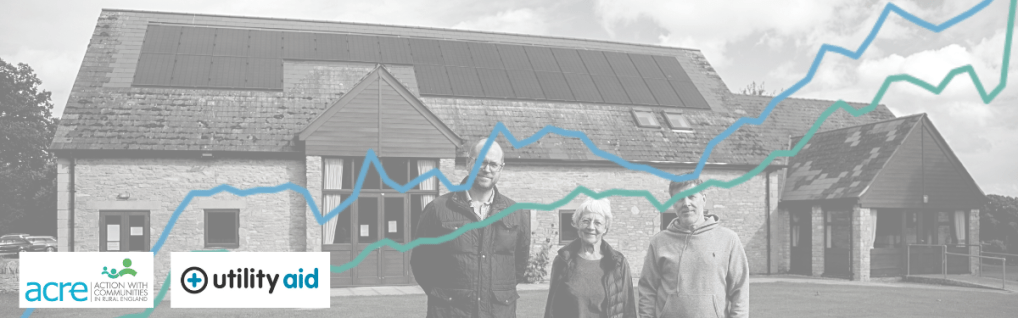

England’s village halls asked about the impact of rising energy prices

A survey is being conducted to better understand the needs of England’s 10,000+ rural community buildings as energy prices continue to soar

National charity and our national body, Action with Communities in Rural England (ACRE) and Utility Aid are calling on volunteer management committees to share their experiences, concerns and views on what can be done to make sure village halls do not run into financial difficulties and save energy.

The move comes amid fears that village halls are not covered by Ofgem’s price cap and may be particularly vulnerable to volatility in the cost of commercially supplied energy which has increased by 166% for electricity and 189% for gas in the past year. According to Utility Aid, prices continue to rise with gas supplied to commercial premises now costing one third more than last week.

The volunteers who manage Hunsdon Village Hall in Hertfordshire are one of many rural community groups voicing concern about the spiralling cost of energy. John Felstead, a trustee of the hall explained, “Like everyone, we have seen our energy bills rise exponentially over the last few years. However, as a charity we do not qualify as a domestic user and are therefore put on a business tariff. This means there is no energy cap. Here in Hunsdon we have a Grade II listed building which was built in 15th century and leaks heat. We would dearly love to improve the insulation, but the Listed Building status make that very expensive. And as a ’not for profit’ organisation, funds are scarce, and we rely on income from hiring out our hall or organising fundraising events to make improvements or repairs.”

Richard Quallington, ACRE’s Executive Director said, “It’s important we understand how village halls are weathering the fuel crisis and what can be done to make sure the services they offer to rural communities are not jeopardised. Many halls were built during the inter-war period and do not always have efficient heating and insulation, so bills are likely to be going – quite literally – through the roof! Ultimately, we want to be in a position where we can help management committees to future-proof their buildings and encourage them to take a leading role in achieving net zero locally. Of course, that will require funding, so this is our first attempt at appraising this need.”

Utility Aid are corporate partners of ACRE. As the largest energy broker for the not-for-profit sector, they want to be able to use information from the survey to offer more targeted support for village halls. Giles Hankinson, Utility Aid’s Chief Executive Officer explained, “The halls we are speaking to day-in, day-out are telling us they are very concerned about increasing energy bills. We are doing everything we can to help them find the best deal, however, more can be done to help these community buildings in the long run. This survey will help to tailor our services according to their needs. At the same time, we are also keen to work with ACRE to find ways of levering in more funding for halls to make sure they can save energy as well as money in the long run.”

The survey is being made available here and responses can be submitted until midnight Friday 19 August.


Could you be the catalyst for the creation of decent, affordable homes in your community?

Community led housing is a growing movement led by ordinary people who are passionate about creating high quality, affordable housing in their communities. These community-led schemes involve extensive consultation to understand local housing need and lead to assets that are owned and/or managed by the community. The homes created can be for occupation by specific groups of people or to meet general affordable housing need in the community and are protected as affordable housing in perpetuity.

There are different models of community-led housing and the definitions can be found on the Collaborative Housing Website. Community Led Homes, a partnership between the Confederation of Co-operative housing, Locality, the National Community Land Trust Network and UK Cohousing, share examples of housing schemes on their website.

The benefits of community led housing are many. This list is taken from the website of the Communities Housing Trust that supports the creation of community-led housing in Scotland:

  • It provides additional supply of homes that would not be available through mainstream housing delivery;
  • Generates community support for new homes;
  • Helps diversify the house building types and tenure options in communities;
  • Assists the local economy and trades provision;
  • Empowers and builds capacity within community groups and sets a positive example to others;
  • Helps to attract financial investment to communities;
  • Improves spaces and the built environment;
  • Provides choice for older people needing age appropriate housing;
  • Gives younger people an opportunity to realise their housing ambitions;
  • Supports sustainable and economically vibrant communities;
  • Helps people afford to rent, buy or build their own homes;
  • Supports an innovative approach to partnership working and to providing solutions;
  • It can support social and economic growth in the community.

In September 2022, CCB will be holding a training event to share examples of community-led housing schemes and to answer your questions about where to start. The event will be of interest to town and parish councils, neighbourhood planning groups and anyone with an interest in affordable housing for their community. To register your interest, please contact Tim Parry at CCB.  


Keeping energy prices cool this summer

We all know that winter is the time when we usually have to look at our energy consumption the most but, as our summer warms up* in the UK due to climate change, we need to stop and think about how we can be energy efficient in the summer too.

This week has seen our first red alert for a heatwave triggered and no doubt most of us have been trying to think of ways to keep a cool head at home. The Centre of Sustainable Energy informs us that it helps us to focus on the things that we use the most, and so costs you the most money. Every electrical appliance has a power rating which tells you how much electricity it needs to work. This is usually given in watts (W) or kilowatts (kW) (1000W = 1KW). Of course, the amount of electricity it uses depends non how long it’s on and this is measured in kilowatt-hours (kWh). Below is a handy table produced by CSE of the biggest drain on energies in your households although unfortunately, it doesn’t show fans and air conditioning units.

ApplianceAverage power rating (Watts)Cost to use per hour (pence)*Cost to use per 10 mins (pence)*
Electric shower7000–10500175-26229–44
Immersion heater30007512.5
Kettle30007512.5
Tumble Dryer2000-300050–758.0–12.5
Electric fire2000–300050–758.0–12.5
Oven2000-220050–558.0–9.0
Hairdryer2000508
Oil-filled radiator1500-250037–626–10
Washing machine1200-300030–755.0–12.5
Dishwasher1050–150026–374.5–6.0
Grill/hob1000-200025–504.0–8.5 
Iron1000-180025–454.0–4.5 
Electric drill900-100022.5–25.03.7–4.0 
Toaster800-150020–37.53.3–6.2
Microwave600-150015.0–37.52.5–6.2
Electric mower500-180012.5–45.02.1–7.5
Vacuum cleaner500-120012.5–30.02.0–5.0
Dehumidifier300-7007.5–17.51.2–2.8
Plasma TV 280-4507.0–11.01.2–1.8
Towel rail250-5006.0–12.51.0–2.2
Fridge-freezer200-4005–100.8–1.6
Freezer15040.6
Heating blanket130-2003–50.5–0.8
LCD TV125-2003–50.5–0.8
Desktop computer80-2002–50.3–0.8
Games console45-1901–50.2–0.8
Fridge40-1201–3~ 0.3
TV box30-400.7–1.0~ 0.1
Laptop20-650.5–1.6~ 0.1
Video/DVD/CD20-600.5–1.6~ 0.1
Tablet (charge)100.2<0.1
Broadband router7-100.2<0.1
Extractor fan5-360.2–0.9<0.1
Smart phone (charge)2.5-5.0<0.2<0.1

*All calculations are based on an assumed unit rate of £0.25p per kWh (at the upper-end of normal range in Jan 2022) and rounded up or down to the nearest 0.5p or 0.1p as appropriate

There is no doubt that air conditioning and multiple fans running are a drain on your home energy and can cause your bills to shoot up. We found a few tops tips from EDF Energy that we can all do in our homes to keep cool and save energy;

  • Open windows throughout your home and get a draught going (if there is one!)
  • Close windows that are open on the sunny side and leave them open on the shady side if that’s possible, opening windows in the evening if safe to do so can also help.
  • Close curtains and blinds when the sun is out to stop rooms heating up
  • Don’t unintentionally heat up your home – avoid using the oven (try raw salads that need no heat to prepare or use the microwave) and turn off lights when they’re not in use

You can also save energy by:

  • Unplugging electronics
  • Keeping the fridge closed – in warm temperatures your fridge can heat quickly and it takes energy for it to cool back down
  • Doing laundry in cold water and then hang it up outside on a washing line

Some top tips to save water can be found here from Thames Water: https://www.thameswater.co.uk/help/water-saving/water-saving-tips-for-summer

You may also find this article from Energy Saving Trust useful: https://energysavingtrust.org.uk/hub/quick-tips-to-save-energy/

If you believe you are at risk of, or currently experiencing fuel poverty we can help. Get in touch with Helen.Dean@ccberks.org.uk for further information and support.

  • A recent study from the MET Office stated; ‘The chances of seeing 40°C days in the UK could be as much as 10 times more likely in the current climate than under a natural climate unaffected by human influence. The likelihood of exceeding 40°C anywhere in the UK in a given year has also been rapidly increasing.”

Spotlight: Increasing digital inclusion and social connectedness in rural areas

The 38 Rural Community Council charities across England, along with our national body, Action with Communities in Rural England, work towards helping communities to identify connectivity challenges and establish community broadband and other solutions. We also aim to tackle digital exclusion and help stimulate digital inclusion initiatives.

During the last year, CCB met with the DiG Digital Infrastructure Programme Manager to discuss rural broadband, especially at village halls. We described the challenges that people in rural areas face with digital connectivity and outlined some potential solutions that could involve well-connected village halls. We have identified ways we can collaborate to support rural communities that need services more quickly than the commercial roll-out of Gigabit broadband will provide.

Over in Cambridgeshire, the Cambridgeshire ACRE has also been liaising between the partnership ‘Connecting Cambridgeshire’ and the network of village halls. This activity has resulted in Wi-Fi connectivity being rolled out to another 26 village halls during the year. More than three-quarters of halls in the county are now able to offer Wi-Fi to their users.

Down in Dorset a series of webinars were delivered by Dorset Community Action on digital skills issues, aimed at voluntary and community sector groups. Their webinar offering has enabled learners to be more aware of common scams, improve their online & social media marketing, and use IT to better budget/fundraise.

Up in Humberside, Humber and Wolds Rural Action has been seeking to improve access to online consultations with local GP practices and the area’s acute hospital. They worked with GP practices to identify people who would benefit from digital skills training, so they could order prescriptions and book health appointments online.

In Cornwall the Cornwall Rural Community Charity has built a free telephone service that advises people how to get online and helps them use electronic devices. They have also provided digital skills home visits and group IT sessions.

We are very proud of the services we are able to offer as a network, tailored to meet our specific county residents’ needs and take inspiration from our counterparts in other parts of England.

In 2021 we held a small focus group with representatives from rural communities in Berkshire to find out where the need we can help improve digital inclusion. The event identified three key barriers that people can face in benefitting from the online world in rural areas: access to affordable devices, access to a reliable and affordable connection and the skills and confidence to use online services.

Out of this, it is our ambition to hold some workshops in village halls in rural areas where we use loaned tablets/hardware to help people with things that some of us find easy but many don’t, such as online banking, shopping, communications and access to health apps. We would like to deliver this in partnership with other agencies and are making inroads with setting this up. If you are able to provide support with gifting hardware or providing skilled volunteers, or would like to share your ideas with us we would love to hear from you. Please contact Tim.Parry@ccberks.org.uk