Connecting Communities in Berkshire Launches New Strategy for 2026-2030

Helping Berkshire communities thrive for the next 50 years

Connecting Communities in Berkshire (CCB) is proud to launch our new Strategic Plan for 2026-2030, setting out an ambitious vision for stronger, more resilient and sustainable communities across Berkshire.

For more than 50 years, we have worked alongside local communities, helping people tackle challenges, seize opportunities, and shape their own futures. Our new strategy builds on this legacy while responding to the issues communities tell us matter most today: affordable housing, rising energy costs, social isolation, and access to essential services.

A vision for thriving communities

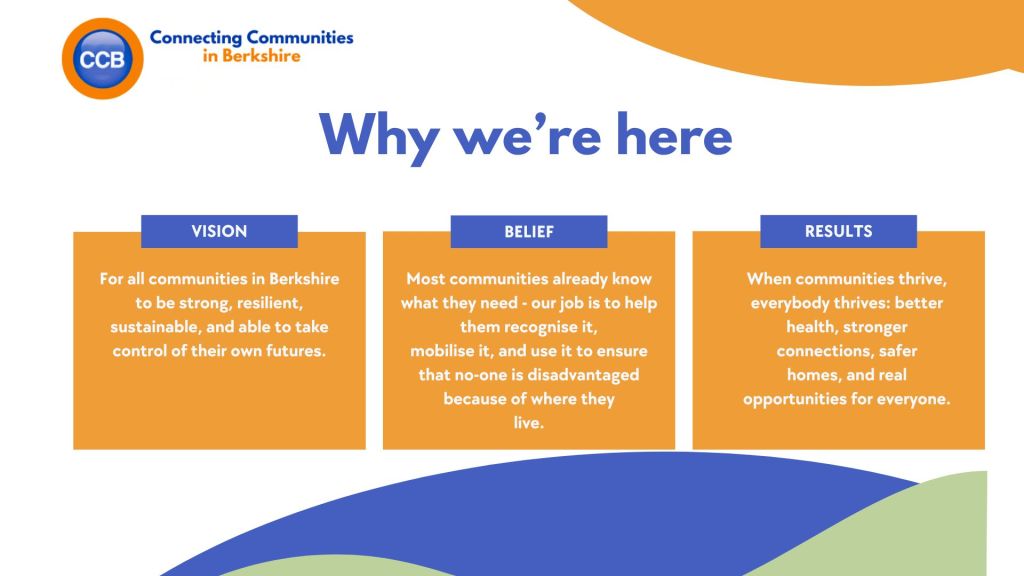
Our vision is simple: for all communities in Berkshire to be strong, resilient, sustainable, and able to take control of their own futures. [

We believe that most communities already have the knowledge, skills and passion they need to create positive change. Our role is to help unlock that potential, ensuring that nobody is disadvantaged because of where they live. When communities thrive, everyone benefits through better health, stronger connections, safer homes and greater opportunities.

Listening to what communities need

The development of our strategy has been shaped by what communities across Berkshire are telling us. Key concerns include:

  • The shortage of affordable homes for local people and key workers.
  • Increasing energy costs and fuel poverty.
  • Growing social isolation and loneliness.
  • Difficulties accessing healthcare and other essential services, particularly in rural areas.

Over the next five years, we will focus our efforts where we can make the greatest difference, working alongside residents, community groups, partners and funders to develop practical, long-term solutions.

Building on proven success

The strategy builds on the impact we are already delivering across Berkshire.

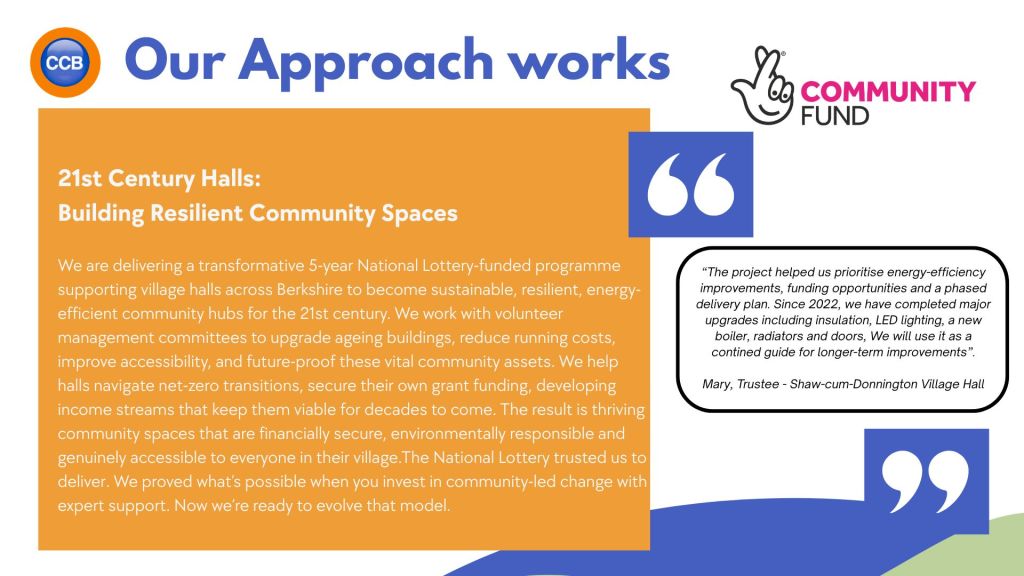
Through our 21st Century Halls programme, funded by The National Lottery Community Fund, we are helping village halls become sustainable, accessible and energy-efficient community hubs. These vital spaces support local activities, services and connections that help communities flourish.

We will continue our work supporting affordable housing solutions, providing independent energy advice, tackling fuel poverty, promoting adult learning, and strengthening community networks across the county.

Five pillars for vibrant communities

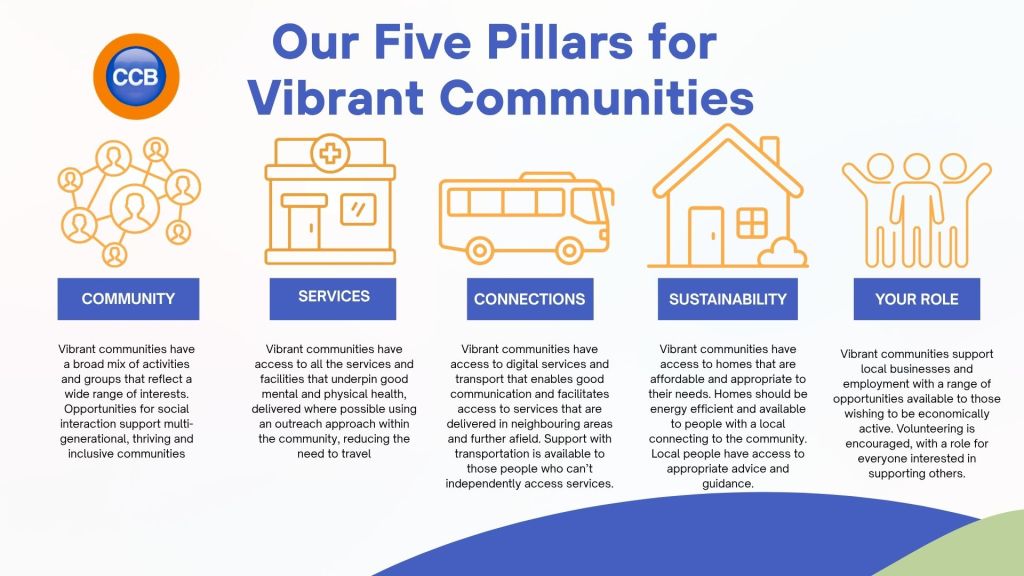
At the heart of the strategy are five pillars that underpin thriving communities:

  • Community – creating places where people feel connected and supported.
  • Services – ensuring access to health, wellbeing and essential local services.
  • Connections – improving social connections, transport and digital inclusion.
  • Sustainability – supporting resilient communities and environmentally responsible solutions.
  • Your Role – encouraging volunteering, participation and local leadership.

Together, these pillars provide a framework for creating communities where people can live well, participate fully and feel connected to the places they call home.

Working at every level

What makes CCB different is our ability to work across the whole community system. We combine trusted grassroots relationships with strategic partnerships and policy influence, ensuring local voices are heard and reflected in decision-making.

As part of the national ACRE network, we are also able to connect local issues with wider conversations about rural services, housing, energy and community development, helping Berkshire communities benefit from national expertise and influence.

Looking ahead

As we begin this new chapter, we remain committed to listening, learning and evolving. Over the coming months we will strengthen partnerships, develop innovative approaches to tackling isolation, and build on the success of our village halls programme to ensure community spaces remain vibrant and future-ready.

We look forward to working with our members, partners, funders and communities to turn this vision into reality.

Together, we can help Berkshire communities thrive. To read the full document please click here.


Government Funding to Help Vulnerable Households with Rising Heating Oil Prices

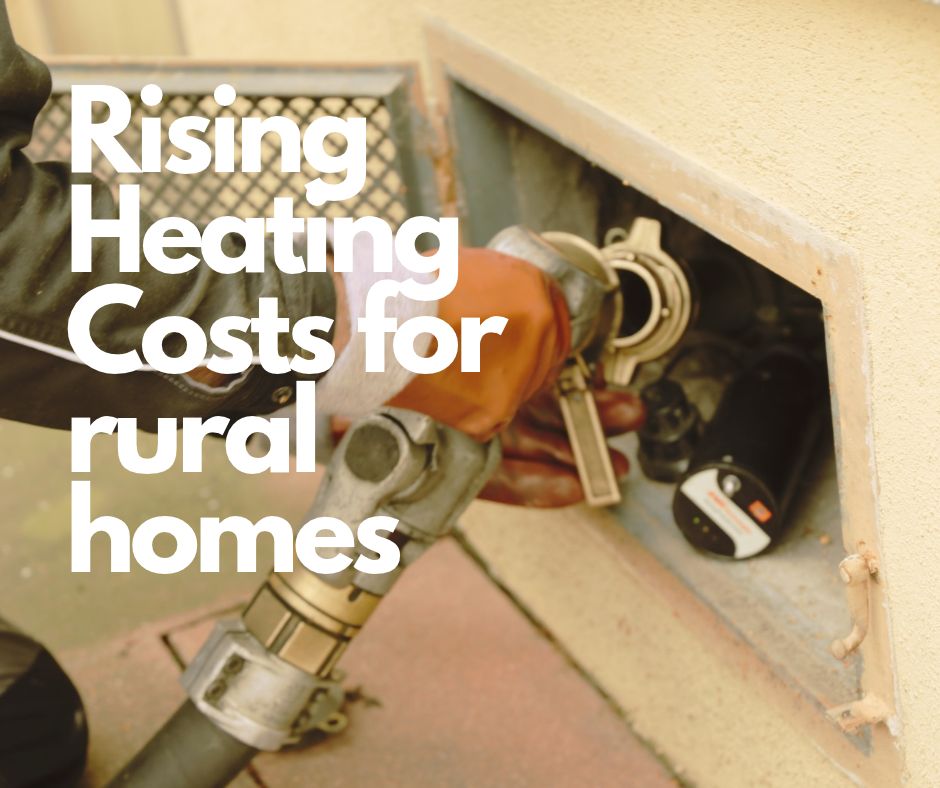
On 16 March 2026, the Government announced £53 million of financial support to be allocated across the nations of the UK to address the rising cost of heating oil. In England, £27 million is being made available, targeted at areas with higher reliance on oil heating, to support people in crisis facing sharp increases in oil heating prices. This support is being delivered through the Crisis and Resilience Fund (CRF). Not every local authority will receive additional funding, but all local authorities are expected to support vulnerable households who use heating oil through their CRF

Vulnerable households in England who heat their homes with oil may be able to get support from their local authority through the CRF. The CRF helps low-income households facing financial difficulties due to a sudden or unexpected cost, including rising heating oil prices. Not every household using heating oil will be eligible – support is targeted at those most in need and eligibility will vary by local authority.

The Crisis and Resilience Fund can be used to support households reliant on alternative fuel sources other than heating oil, such as LPG. Guidance to Authorities is clear that Crisis Payments can be used to support energy costs for any form of fuel used for domestic heating, cooking or lighting, including oil or portable gas cylinders. It is for Authorities to determine individual need and the most appropriate form of support, using a person-centred, needs based approach in line with the Fund’s guidance.

Visit your local authority’s website (latest links below) or contact them directly if you think you may be eligible for support.

West Berkshire Council: https://www.westberks.gov.uk/article/45533/Crisis-and-Resilience-Fund
Royal Borough of Windsor & Maidenhead: https://www.rbwm.gov.uk/community-and-living/community-support/here-help
Wokingham Borough households: https://www.wokingham.gov.uk/cost-living/crisis-and-resilience-fund
Latest from Slough Borough: https://democracy.slough.gov.uk/mgIssueHistoryHome.aspx?IId=50951&Opt=0
Latest from Reading Borough: https://www.reading.gov.uk/benefits-and-financial-support/money-matters/crisis-and-resilience-fund/
Latest from Bracknell Forest Council: https://www.bracknell-forest.gov.uk/benefits-and-support/crisis-payment-scheme


Environmental Spotlight: Solar Panels in Village Halls

 by Kate Meads, Community Buildings Advisor

In 2025 solar panels are becoming a more common feature of many Village Halls.

We estimate that by the end of 2026 more than 20% of our member halls will have installed them.

Members cite multiple reasons for installing Solar Photovoltaic Panels. The most common ones are:

1. Reduce Energy Costs – Solar energy is free!

2. Environmental Sustainability – Solar energy is clean and renewable, helping reduce the hall’s carbon footprint. Supports local climate action goals and demonstrates environmental leadership.

3. Access to Grants and Funding – There are a number of grant makers who prioritise funding for environmental efficiencies

4. Energy Independence – Solar panels with battery storage allow halls to generate and store their own electricity. Reduce reliance on the national grid, and protect
against energy price volatility.

5. Community Engagement and Education – Installing solar panels can raise community awareness about renewable energy. It encourages other local buildings and residents to consider sustainable options. Both Chieveley and Beech Hill Village Halls see this as important.

6. Long-Term Investment Solar panels typically last 25–30 years, offering long- term savings. They increase the value and appeal of the hall for future generations.
As energy costs increase, the return on investment can be shorter and attractive.

7. Monitoring and Transparency- Many systems come with apps or dashboards that show real-time energy generation and usage. Which help committees manage energy more efficiently.

The staff at CCB would like to applaud all our forward thinking Management Committees!

Among the early adopters of solar panels were Sulhampsead and Ufton Nervett Village Hall, Padworth Village Hall, The Cornerstone (Wokingham), Basildon Village Hall, Burghfield Scouts Hut and East Garston Village Hall.

Halls who have installed Solar Panels since the start of CCB’s 21st Century Community Halls Project are: California Ratepayers Hall, Finchampstead Memorial Hall, and Beech Hill Village Hall.

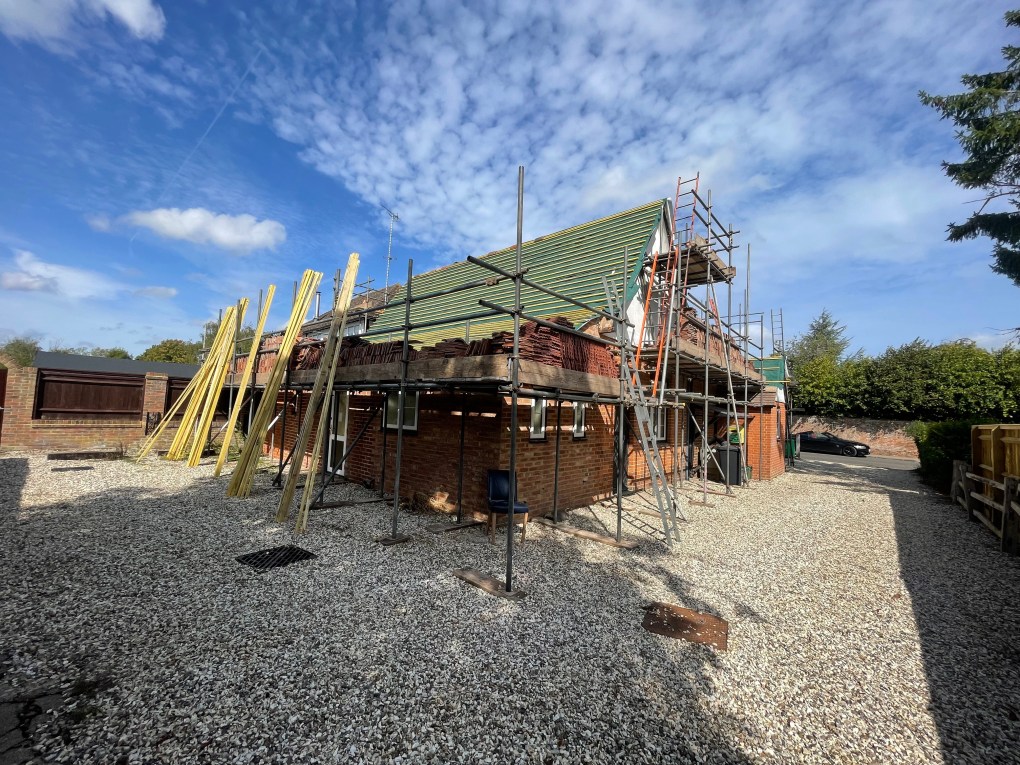
This summer sees Chieveley Village Hall, Arborfield Village Hall (pictured above), Bradfield Village Hall and West Ilsley Village Halls making their installations.

More Halls have plans to install solar soon, among these are St John’s Crowthorne, Hampstead Norreys Village Hall and Bucklebury Village Hall.

Any questions?Email: kate.meads@ccberks.org.uk


Building Futures: Spotlight on Rural Housing at National Conference

Connecting Communities in Berkshire joins national call to action for affordable rural homes

We were proud to take part in the recent Rural Housing Conference, held on 30 April 2025 at the historic Coram campus in London. Organised by English Rural and Action with Communities in Rural England (ACRE), the event gathered policymakers, housing professionals, and community advocates to confront the urgent and growing crisis in rural housing.

Attending on behalf of CCB was Rural Housing Enabler Maria Kelly, who joined others in championing the importance of truly affordable homes for rural communities.

The conference, titled Affordable Rural Housing: Opportunity in Changing Times, was marked by a keynote address from HRH The Princess Royal. She offered a powerful reminder that rural housing is about more than buildings:

“We aren’t just talking about houses — we’re talking about the people and communities that make our countryside live and breathe.”

The day laid bare the depth of the challenge facing rural areas:

  • The average rural house price has reached £418,400, compared to average rural earnings of just £25,600.
  • Only 10% of new affordable homes are built in rural areas, though these areas are home to 18% of the population.
  • Investing in rural housing could unlock as much as £87 billion a year in productivity, while strengthening local economies and jobs.

Speakers from across sectors—including planning, faith groups, and economic development—urged a coordinated national effort. Solutions discussed included planning reform, incentives for landowners, and sustained funding for Rural Housing Enabler programmes.

Photo by Matt Pereira Photography / English Rural

Maria said: “What really struck me was how deeply rural housing is tied to community life. Affordable homes mean local families can stay close, young people can build their futures, and essential services can survive. There’s a real opportunity now to make lasting change, and I left the conference energised and hopeful about what we can achieve together.”

Dame Fiona Reynolds captured the overarching theme of the day:

“This is about building more than homes. It’s about building futures.”


Village Halls Week 2024 set to ‘go green!’

Phillip Vincent, Public Affairs and Communications Manager from out national body Action with Communities in Rural England (ACRE), blogs ahead of Village Halls Week which is set to return for the seventh year running and challenge community buildings to consider how they can save energy and support environmental initiatives that help with Net Zero.

With scientific warnings of the climate crisis mounting and governments and international institutions scrabbling in search of grand solutions, it’s easy to feel powerless to act in the face of great threats to our way of life, and that of future generations.

But as much as bold decisions are needed regarding the global management of the Earth’s resources and the carbon emitted into the atmosphere, little will happen unless there is action on the ground.

Rural communities have great potential to be pioneers in the local battle for Net Zero. This is likely to include adopting more sustainable agricultural practices, welcoming renewable energy generation, improving the energy efficiency of older buildings and reducing the need for people to travel by utilising digital technology. Mitigation too is needed to blunt the consequences of climate change such as flooding and wildfires.

Village halls, like parish councils, are one of very few institutions embedded in nearly every corner of rural England. Hosting a wide range of activities, events, groups, and services, they have great reach into communities. Many have been used as a place of refuge during extreme weather events. And as the Post Office Horizon scandal has recently brought to light, they are sometimes venues where radical community activism begins!

The humble village hall is therefore surprisingly well placed to be a catalyst for environmental action. Village Halls Week 2024 will consider how this can happen. It will look at what some halls are already doing to serve as inspiration, and it will provide an opportunity for others to hold events and reach out to residents to see what might work locally for them.

A highlight of this year’s campaign will be the publication of a Net Zero Design Guide for Village & Community Halls produced by stagg architects on behalf of ACRE.

Typically, village halls are older buildings which can be off the gas grid. Some date back over 100 years. Many have been vulnerable to energy price shocks over the past couple of years with some groups spending over half of their income keeping the building warm at the peak of the crisis.

On this basis, a logical, and much needed starting point for village hall groups interested in ‘going green’ is making improvements to their building to reduce the amount of energy they consume as well as their bills.

The guidance set to be launched via a livestream features several halls in Cumbria, Lancashire, Buckinghamshire, Dorset and Somerset which have done just that. Work undertaken by these halls include improving insulation, upgrading heating systems and even generating their own energy. They demonstrate that whilst there’s no one size fits all solution, there are many take home lessons from their experiences with regards to project planning, involving the wider community, fundraising, and working with technical experts and contractors.

For more information about Village Halls Week, please visit: https://acre.org.uk/village-halls-week-2024/