
Could existing rural housing sites provide more and better affordable homes without finding new land?
Older rural homes can be costly and complicated to improve. Selling them may ease housing associations’ financial or maintenance pressures but
removes both the homes and the land they occupy from the affordable housing supply. Replacing that provision is difficult, even before addressing emerging housing need.
Work is under way to explore a portfolio approach to protecting and improving rural affordable housing across the Rural Thames Valley area: Berkshire, Oxfordshire, Buckinghamshire and Wiltshire. The initiative grew out of discussions about two connected challenges: finding land for new rural affordable homes and the loss of existing homes through open-market sales.
The work is being undertaken by Altair, a housing consultancy specialising in affordable housing, with funding contributions from West Berkshire Council and housing associations SOHA and Housing Solutions. Connecting Communities in Berkshire (CCB) is coordinating the initiative on behalf of the Rural Thames Valley Partnership.
What is a portfolio approach?
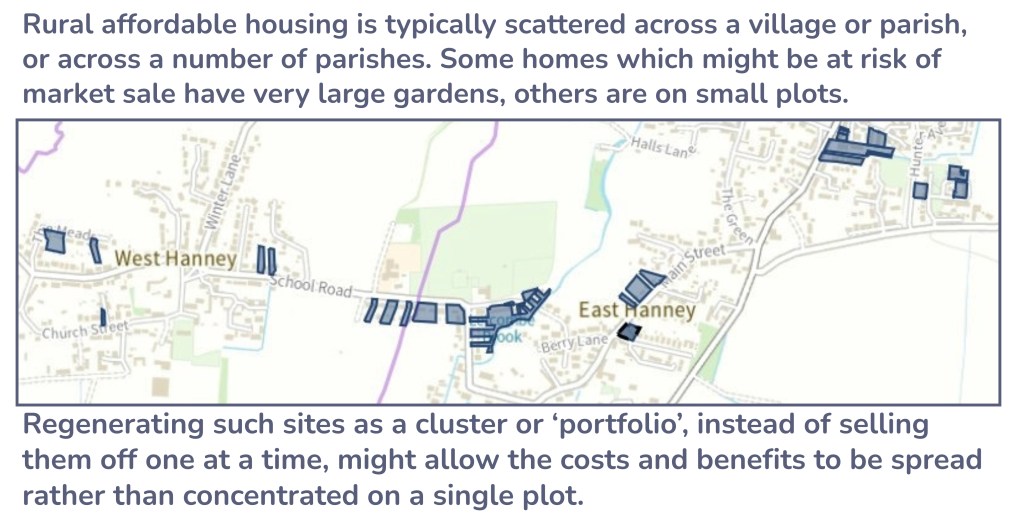
A portfolio approach considers several sites as one longer-term programme. A site with an affordable rented home that is costly or difficult to redevelop on its own could be assessed alongside others with room for additional homes. Combining their costs and opportunities could offer a way to retain affordable housing land while replacing older homes and increasing supply across the cluster.
This initial study focuses on costs and financial viability, rather than planning issues or social and environmental impacts. It is a starting point for deciding whether the approach merits further exploration, not a commitment to redevelopment.
A potential route to regeneration funding
Homes England’s Social and Affordable Homes Programme 2026–2036 can support replacement homes where regeneration unlocks additional social and affordable housing, including across a portfolio of sites. This could allow homes to be replaced on some rural plots while more are added on others, without every plot needing to deliver an increase.
The study could inform discussions with Homes England about applying this opportunity to small, scattered rural sites. Any future development funding would depend on eligibility, value for money, deliverability and Homes England’s assessment. The partners’ contributions fund this study, not a programme award.
Putting the idea to the test
Altair’s modelling will look at several agreed case-study sites, with the funding partners helping to select sites and test assumptions. It will assess potential housing capacity, development costs and funding gaps, then consider the sites together and test the effect of changes in costs and values.
Short case studies and a summary report will set out the opportunities and limitations. Further questions include how to phase redevelopment as homes become vacant and how to secure suitable funding.
Once the work is complete, Altair will present its report to members of the Rural Thames Valley Registered Providers Forum to inform discussions about next steps. Whatever the findings, it is hoped that the work will encourage more registered providers, local authorities and communities across Berkshire and the wider Thames Valley to explore creative solutions to the loss of rural affordable homes through open-market sales.

